
For decades now, the enterprise has followed a predictable pattern: people make decisions, machines execute instructions, and security is built around that two-actor model.
A third actor has now entered the enterprise, and it behaves differently from anything that came before. Agentic AI systems interpret intent, reason in real time, and take action across systems on our behalf. As soon as they began operating inside businesses, long-standing security assumptions started to break.
Why This Moment Is Different
Enterprise security has faced disruptive shifts before. As work became mobile, the perimeter eroded. As cloud adoption accelerated, infrastructure ownership faded. As SaaS spread, control fragmented across the organization. Each time, security raised valid concerns, and each time the business moved forward anyway.
Agentic AI follows the same pattern, but on a far more compressed timeline. These systems collapse the distance between decision and execution, operating across environments enterprises do not own and at speeds humans cannot match. Changes that once unfolded over years are now happening in quarters.
This shift is not driven by experimentation. It is driven by efficiency. Organizations adopt technologies that remove friction from work, even when security models lag behind. Agentic AI does exactly that.
Data as the Foundation to Security
Data creation continues to surge into the hundreds of zettabytes. Every application, model, and agent consumes and produces data, turning nearly every business into a data business by default. Yet many organizations still lack clear visibility into their data. They struggle to understand what exists, where it lives, who can access it, and how sensitive or valuable it is.
These questions were once framed as governance issues. Agentic AI pushes them directly into business strategy. Models learn from data, and agents act on it. When data is poorly understood, intelligent systems amplify blind spots rather than reduce them.
Data without protection becomes risk. Security without data context becomes guesswork.

The Security Impact of Agents
Traditional security models assume two identities: humans with intent and machines that follow instructions. Agentic AI breaks that assumption. Agents act with human-like autonomy at machine scale. They log in as users, interact with applications on their behalf, and make decisions based on inferred goals rather than explicit commands. Most security tools were never designed to reliably distinguish between a person and an agent acting in their place.
As agents become embedded in everyday workflows, identity boundaries blur, access expands naturally, and behavior becomes harder to interpret, even when actions appear legitimate. The productivity gains are undeniable, but the risk implications are equally significant.
Agents Are Superhuman, and Fragile
Agentic AI introduces a paradox security has never faced before. These systems are superhuman in capability and fragile in judgment. Agents process information at extraordinary speed, operating across dozens of applications simultaneously. They act in parallel without fatigue, making them powerful force multipliers for human productivity.
At the same time, they lack discernment. Optimized to assist and comply, agents struggle to distinguish authority from persuasion or legitimate requests from subtle manipulation. They combine immense power with unexpected gullibility. Enterprises have never deployed actors that move faster than humans, access more systems than traditional software, and yet require closer oversight than either.
When Intent Meets Scale
The real challenge of agentic AI is not autonomy in isolation. It is what happens when intent-driven systems operate at machine scale.
Traditional systems execute explicit instructions, making failures relatively easy to trace. Agents interpret goals, infer meaning, and decide how to achieve outcomes without being told exactly how to proceed. When behavior is driven by inferred intent, attribution becomes ambiguous. It is no longer always clear whether an action was taken by a user or by an agent acting on their behalf, or whether a system did what it was told or what it believed was appropriate. Security tools built for deterministic systems struggle in this environment. As intent replaces instruction, visibility and policy must evolve with it.
The challenge is not simply that there will be more agents. Scale fundamentally breaks human-centered control models. Humans process information sequentially. Agents operate continuously and in parallel across workflows and systems. As agents proliferate, manual reviews, approvals, and exception handling cannot keep pace with machine-speed activity. Controls designed for a world where humans were the bottleneck no longer hold when intelligence operates independently at scale.
Autonomy Demands Guardrails Built for Intelligence
Organizations are rapidly increasing the autonomy granted to AI systems across the enterprise. The solution is not to slow adoption, but to design for autonomy intentionally. Autonomy exists on a spectrum and must be governed dynamically. Guardrails must understand data sensitivity, observe behavior in context, and intervene precisely when risk emerges. Static rules are insufficient. Intelligent systems require controls that can reason alongside them.
If intent and scale are what break traditional security, then visibility and orchestration are what replace it. As enterprises consume applications, platforms, and AI primarily as services, many traditional security levers disappear. Infrastructure is no longer owned, applications operate beyond the perimeter, and models run behind abstractions legacy tools cannot reach.
What remains within reach becomes critical. Understanding data, access, and behavior together forms the foundation of modern security. When treated as a unified system, security moves beyond reactive monitoring and becomes orchestration, enabling innovation while managing risk in real time.
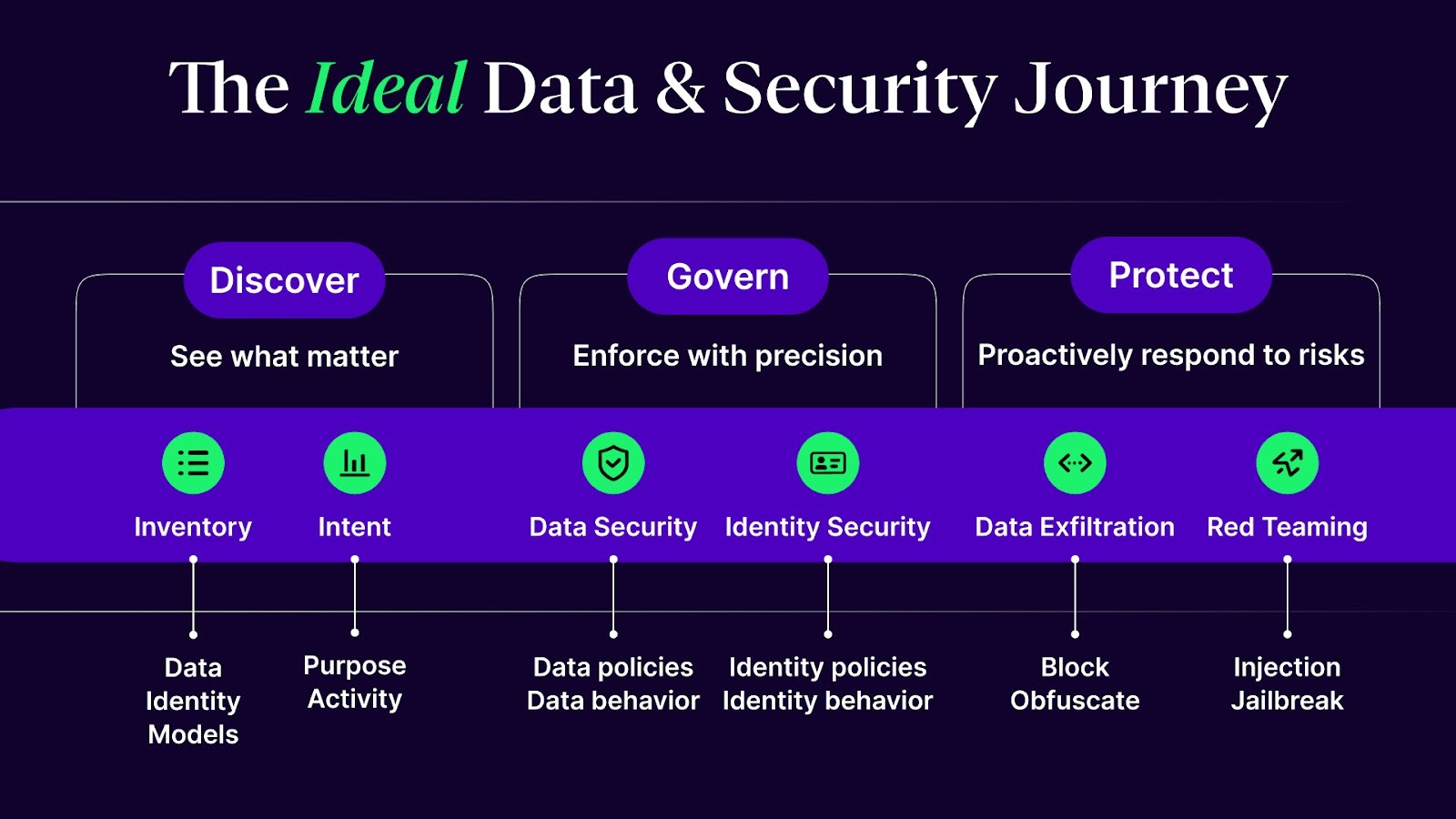
Security as an Orchestrator of Intelligence
For decades, security teams have enabled the enterprise by building resilient foundations and protecting critical systems and information.
In an environment where systems reason, agents act, and data flows continuously across environments, that role can expand even further. Security leaders can shape how intelligence is deployed, how autonomy is granted, and how decisions propagate through the organization.
Security’s role is no longer to slow change or enforce static controls. It is to govern how intelligence operates across the enterprise. The organizations that succeed will be those that treat security as an orchestrator of intent, access, and behavior at scale.

Get your AI Security Assessment



.svg)