

Sensitive data programs don’t stall at discovery. They stall after classification.
By that point, security teams inherit a flood of findings but still cannot answer the questions leadership needs in order to act: what matters most to the business, what is urgent right now, what control should apply, and what gets fixed first.
In most environments, classification produces the same pattern: hundreds of labels, millions of findings, and a backlog of “we should address this” that never becomes prioritized work. Classification can tell you what types of sensitive data exist. Reducing risk requires translating those signals into business meaning.
That is where momentum slows. Teams can find and label sensitive data, but they still cannot tell what it means in business terms, or what to fix first.
Cyera built Topics for this moment.
Unlike approaches that primarily roll up or group labels, Topics is an LLM-powered business context layer that uses classifications as signals, then applies intent and full document context to map data to the business concepts that matter.
The result is a smaller set of meaningful concepts, such as M&A planning documents, product formulas, customer contracts, clinical trial data, or financial planning and forecasting, that security teams can prioritize, govern, and remediate.
Topics is also customizable by design. Instead of forcing every organization into a fixed set of categories, Topics lets customers bring their business taxonomy to life inside Cyera. Teams can define the business concepts that matter to them in their own language, and Topics adapts as priorities change. When a new priority appears, teams can define it in plain language and make it a first-class concept in the platform.
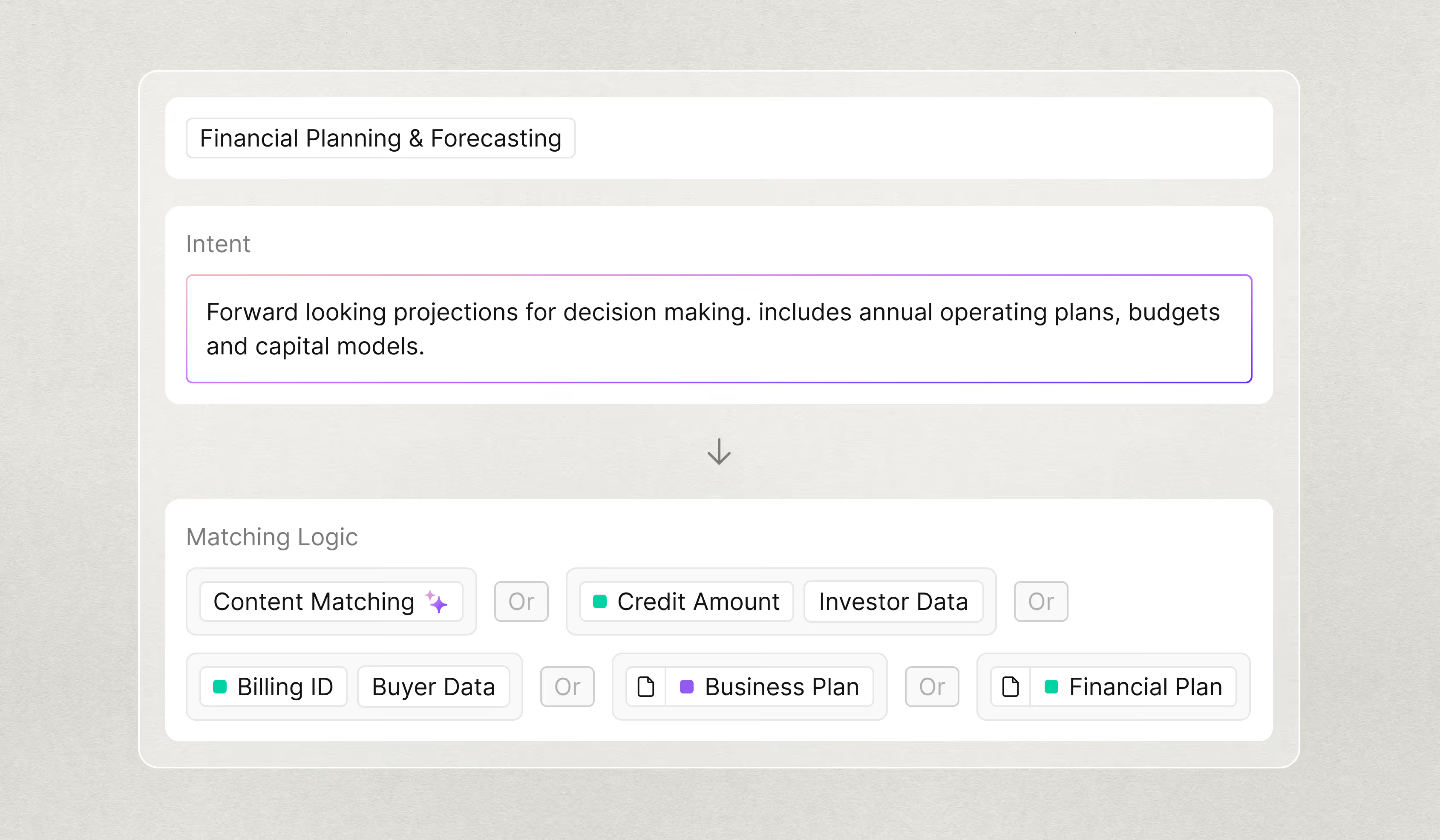
Create a Topic in plain language to bring your business taxonomy to life in Cyera.
Where Sensitive Data Programs Get Stuck After Classification
When sensitive data is organized only as individual classifications, three problems appear quickly.
Prioritization becomes debate.
A long list of labels does not make it clear what to fix first, especially when priorities shift due to acquisitions, investigations, audits, or new initiatives.
Risk communication loses urgency.
“Here are 40 classification types” rarely drives action. “Confidential M&A planning documents are broadly accessible” does.
Controls become brittle.
Policies built from long lists of labels create sprawl and ongoing tuning. As new content appears and patterns change, teams revisit the same logic repeatedly, even when the underlying signals are accurate.
Security leaders do not need more findings. They need a decision-ready view of risk that the business recognizes and will act on.
Topics: A New Business Context Layer
Classification produces signals: labels that indicate what types of sensitive data may exist. But signals alone do not tell teams what matters most to the business, or where risk should be reduced first.
Topics turns those signals into business-aligned entities such as:
- M&A planning documents
- Product formulas
- Customer contracts
- Clinical trial data
- Payment data
- Employee records
- Pricing strategy
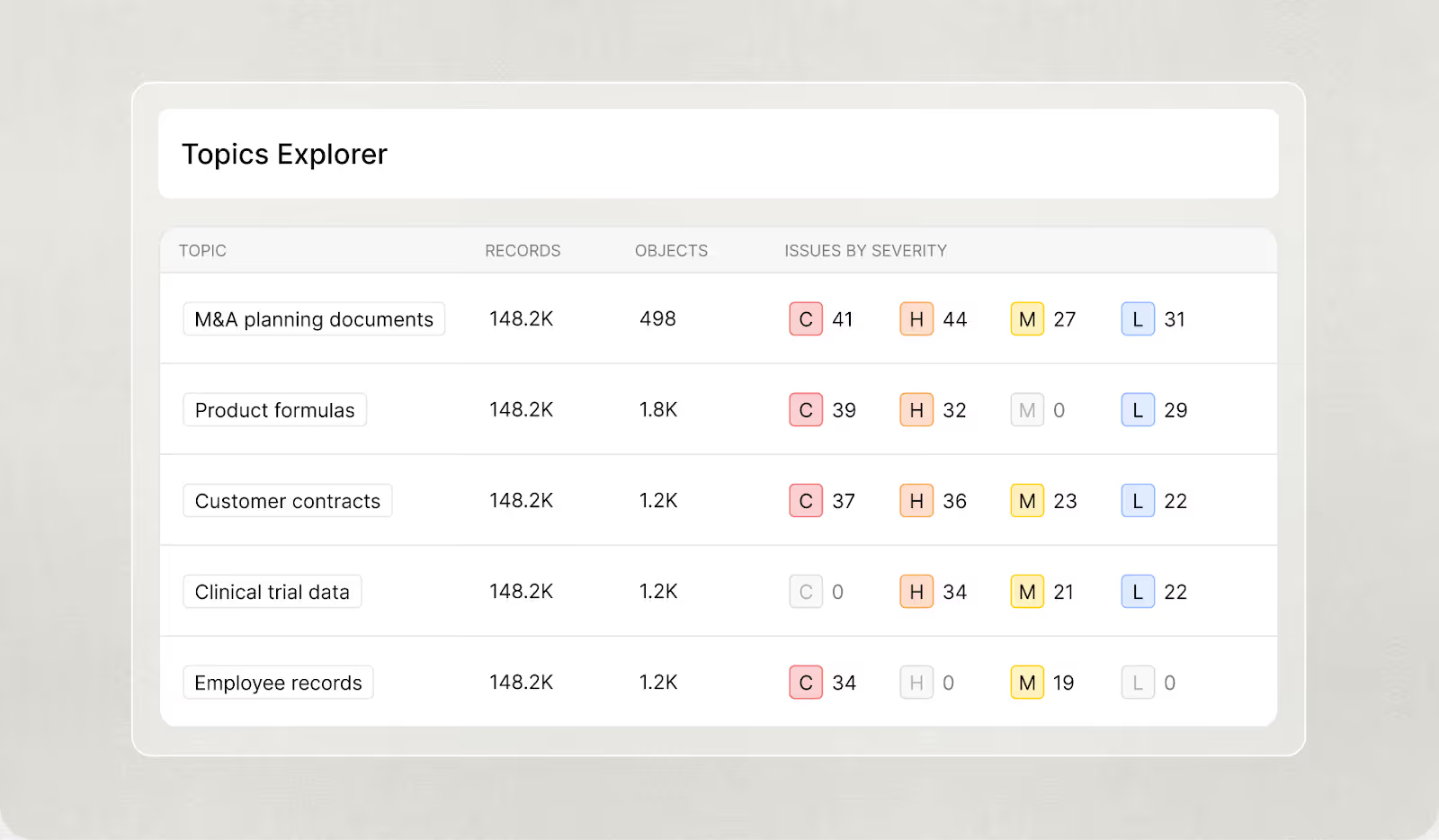
Explore sensitive data risk by Topic to see what matters most and where exposure concentrates.
Instead of managing hundreds of granular classifications, teams can prioritize and remediate around the concepts that represent real organizational risk.
Under the hood, Topics evaluates intent and full document context to determine what a document represents against the business concepts defined in your taxonomy, not just keywords.
In practice, this shift changes how teams discover and remediate real risks.
From Signals to Action: A Real Customer Example
Here’s a real customer scenario we’ve seen in practice.
A global enterprise discovered highly confidential merger-related documents broadly shared via public OneDrive links. Traditional classification detected sensitive signals across the files, but the risk was scattered across labels and locations.
Using Cyera’s learned classification signals and Topics, the security team surfaced the M&A theme, including an internal project codename learned from document context, without manual rules or model training. Documents that mentioned merger keywords but were not true M&A planning materials were excluded, because Topics matched intent and meaning, not just terms.
That made the remediation surface immediately clear, enabling the security team to revoke public access ahead of a public merger announcement. Instead of sifting through individual classifications, the team could act on the business concept itself.
Why Topics Works in Real Environments
Topics works because it uses an LLM to evaluate intent and full document context, treating classifications as signals rather than the final answer.
It is not keyword matching, and it is not “searching your data and stitching together excerpts” to answer a prompt. Instead, it is intent- and context-based classification that maps content to the business concepts defined in your taxonomy.
Three LLM-powered capabilities make this possible.
Intent-based understanding
Topics evaluates what a document supports or represents, such as acquisition planning or product strategy, rather than relying only on the presence of specific terms.
Context-aware interpretation
Signals are interpreted within full context, helping distinguish between similar phrases used in very different business scenarios. For example, a document that mentions “invoice” might belong to employee-related records in one case, and corporate financial forecasting and reporting in another.
Prompt-defined Topics (your taxonomy, in plain language)
Teams can define business concepts in plain language, essentially writing a prompt that describes the concept they want to find. This can include internal terminology, project code names, or business-specific language, and Topics applies those definitions consistently across the environment.
The result is straightforward: classification remains valuable as a signal layer, while Topics converts those signals into entities teams can prioritize, govern, and remediate.
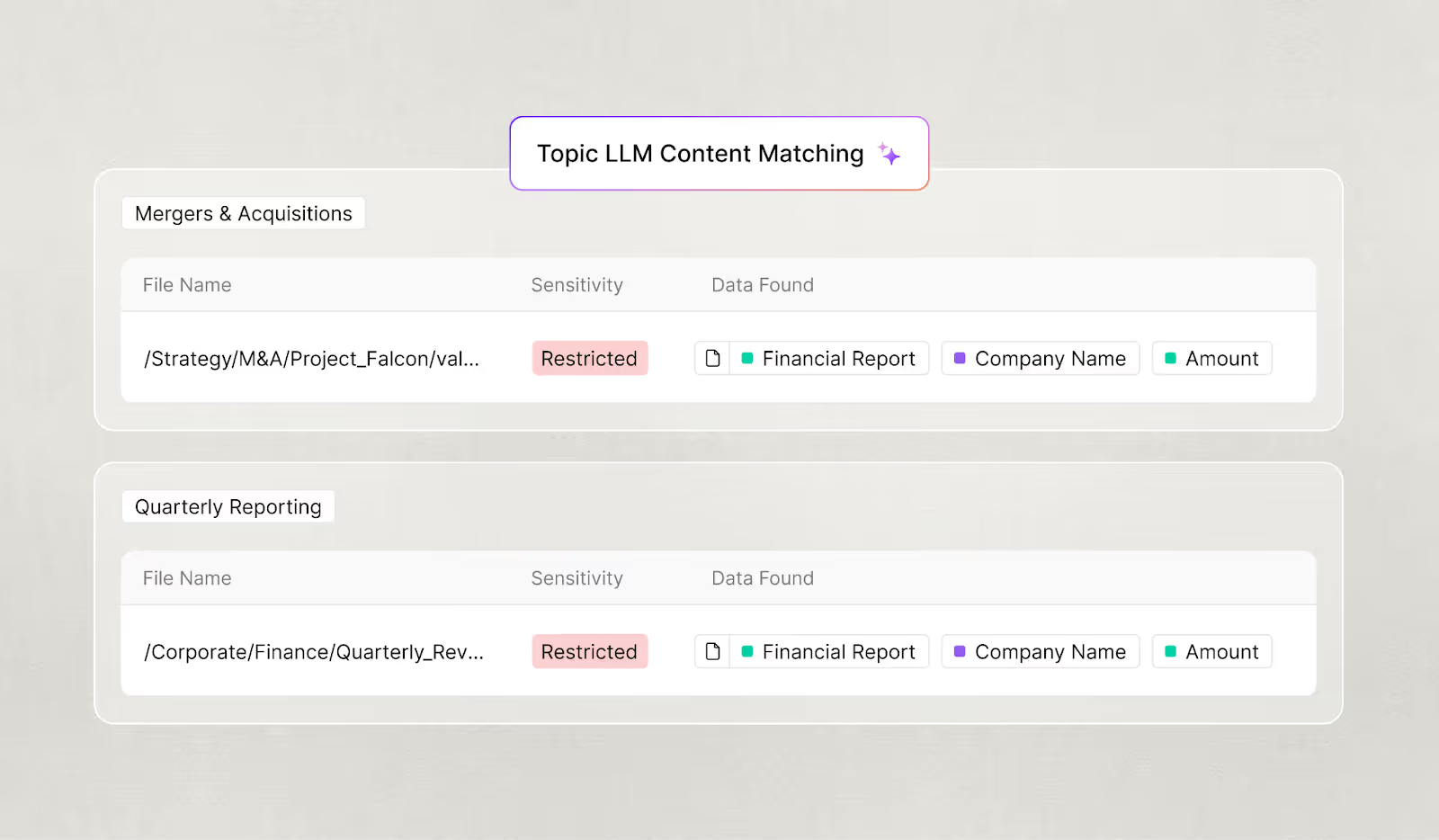
LLM-powered matching uses intent and full document context to map content to the right Topic, not keywords alone.
Defining Business-Aligned Concepts in Plain Language
Some of the most important sensitive data concepts inside an enterprise are not standard categories. They are business-specific, time-bound, and filled with internal terminology.
With Topics, teams can define what matters in plain language. For example:
- “Documents related to merger planning, acquisition targets, and integration strategy, including internal project code names.”
- “Materials related to subsidiary integration planning, operating model changes, and consolidation activities.”
This goes beyond stitching together existing classes like “SSN” and “Full Name.” Topics lets teams define business-specific classifiers on demand for concepts that do not map cleanly to regulated data types or static taxonomies.
When teams realize they can describe a business concept in plain language and quickly find the data that matches it across the environment, Topics becomes a practical way to operationalize sensitive data risk, not just label it.
Responding to New Business Priorities Without Rescanning
Sensitive data priorities rarely stay static.
An acquisition enters diligence.
A subsidiary integration becomes urgent.
An investigation requires “everything related to X.”
A product code name becomes business-critical overnight.
Topics is built for this reality. Once a Topic is defined, it can be applied both going forward and retroactively without requiring a full rescan of the environment. Security teams can respond to new priorities in days, not scan cycles.
Turning Insights into Action
Topics makes classification operational by turning scattered findings into a decision-ready view of risk. Teams can prioritize exposure by business concept, see where that concept concentrates, understand why it is exposed, and remediate the highest-consequence areas first, with traceability back to the underlying signals.
In practice, that changes three things.
Prioritization becomes decisive.
Teams can compare exposure across business concepts and focus on what carries real consequence now, like active M&A planning or clinical trial documentation, instead of debating individual labels.
Controls become simpler and more durable.
Policies and workflows can be aligned to stable business concepts rather than stitched together from long label lists, reducing tuning and policy sprawl as content changes.
Risk communication drives action.
Business-readable statements like “M&A planning documents are broadly accessible” create urgency and alignment, while drill-down evidence keeps decisions defensible for audit and incident response.
What Changes When Sensitive Data Risk is Organized by Topics
Modern enterprises have made major progress on discovery and classification. The remaining challenge is operational: translating millions of sensitive data signals into clear decisions about what matters, what is exposed, and what should be fixed first.
Topics addresses this post-classification problem by organizing classification signals into meaningful operational units.
By shifting the unit of work from granular labels to business-aligned Topics, security teams can prioritize faster, apply durable controls, and communicate risk in terms the organization understands.
Sensitive data security becomes not just discoverable, but operational.
See Topics in action. Request a demo today.
Cyera LLM-Powered Topics FAQs
Q.) What are Topics in sensitive data security?
A.) Topics are business-aligned operational units that map sensitive data findings into meaningful business concepts, so security teams can prioritize and remediate risk based on organizational impact.
Q.) Are Topics just a grouping of data classes or labels?
A.) No. Topics is not a manual bundle of data classes. Topics uses an LLM to treat classifications as signals, then applies intent and full document context to determine what the content represents in business terms. That means documents with similar keywords can map to different Topics, and “keyword-only” documents that do not match the intended meaning can be excluded.
Q.) How do Topics improve sensitive data risk prioritization?
A.) Topics translate granular classification output into coherent business concepts, making it easier to decide what matters most and what to fix first. This reduces time spent debating individual labels and helps teams focus on the highest-consequence areas of exposure.
Q.) Do Topics replace data classification?
A.) No. Topics builds on classification rather than replacing it. Classification provides the underlying signals, and Topics interprets those signals using business context and your taxonomy to organize findings around what matters most to the organization. The result is a decision-ready view that helps teams prioritize risk and take action, while preserving traceability back to the underlying signals and evidence.
Q.) Can Topics be customized for specific business needs?
A.) Yes. Topics are customizable by design and allow teams to define business-specific concepts in plain language, including internal terminology and project code names. This brings a customer’s business taxonomy to life inside Cyera and keeps the unit of work aligned to what matters most.
Q.) Do Topics require a full rescan of the environment when priorities change?
A.) No. Once a Topic is defined, it can be applied going forward and retroactively without a full rescan of the environment, so teams can respond quickly when priorities shift.
Q.) How do Topics simplify policy management and controls?
A.) By expressing policies and workflows at the Topic level instead of stitching together long lists of labels, teams reduce policy sprawl and ongoing tuning. Controls become simpler to manage and more durable as content and patterns change.

Get your AI Security Assessment
.jpg)
.jpg)

.svg)