More Code, More Patches, Faster Attacks: Why Outages May Keep Coming
AI is speeding up code releases, vulnerability discovery, and attacks. Here's why outages are rising and four steps to limit the impact.

In less than a week in mid-November, a string of outages hit some of the biggest names in tech, finance, and the U.S. government. Microsoft Outlook and Teams went down for millions of people on Nov. 12. The next day, a router swap at an FAA site in Arkansas triggered a nationwide ground stop for about four hours, according to U.S. officials. Over the next few days, JPMorgan Chase customers ran into problems, internal communications at the NSA went down, and Apple’s iCloud and Apple Pay stopped working.
Many people’s first assumption was that AI or a cyberattack was behind the string of failures. Officials and the companies involved said the causes were much more routine — a buggy update, scheduled maintenance, or new network equipment.
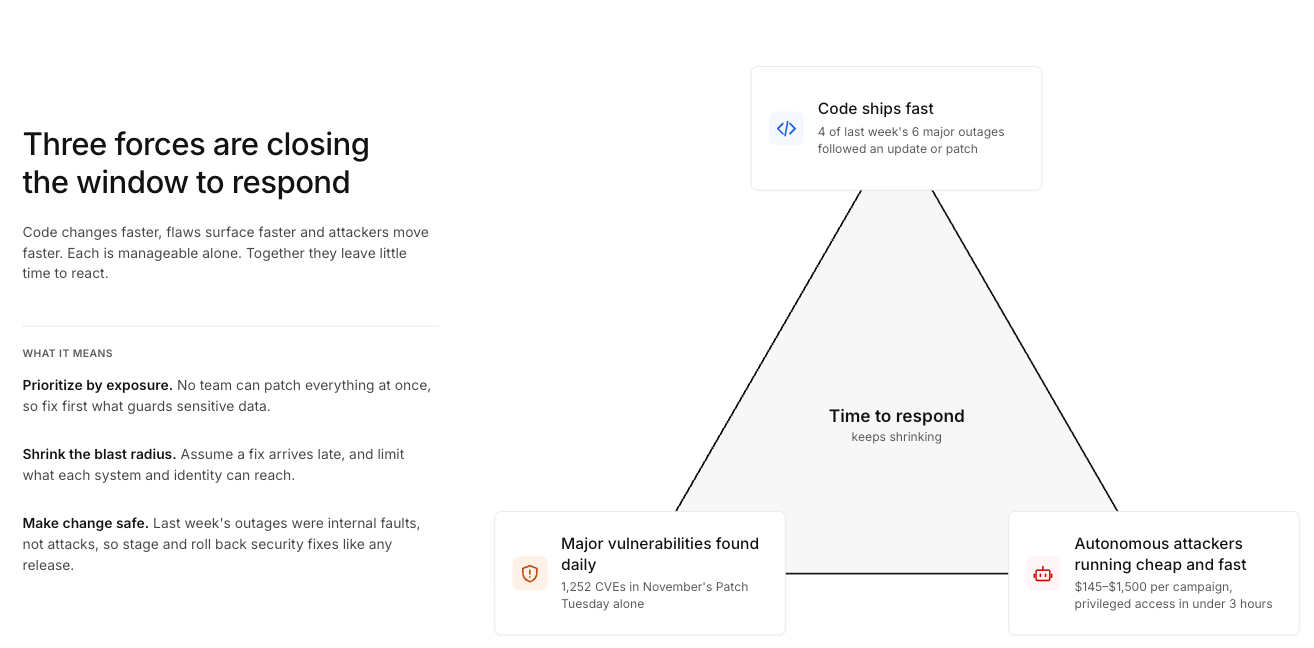
Those explanations make sense to me, but I think AI is creating the conditions that make outages like these more common. It’s speeding up three things at once: how fast code ships, how fast bugs are found (and the volume of patches to fix them), and how fast attackers can use them. The old processes just weren’t built for that pace.
Code ships faster than reviews can scale
A few years ago, a very strong developer might submit two or three pull requests a day. Some of the most productive developers I see who use AI coding tools heavily now submit 30 to 60 in one day. Every one of those PRs is another opportunity for bugs and unexpected problems. It’s the side effect of a much larger volume of code.
AI also adds things you don’t ask for. You’ve likely seen this if you’ve asked your favorite agent to help you build a slide deck or write something. It will include a few lines that don’t fit with the rest of the content. It’s the same with code, except it hits your production environment.
The research backs this up. A Harvard working paper by Fiona Chen and James Stratton that tracked developer activity across 650-plus companies found that as the number of pull requests has increased, the share of pull requests sent back for fixes nearly doubled.
Bugs are being found faster than teams can patch them
A decade ago, the industry saw a vulnerability big enough to interrupt the online tasks people do every day maybe two or three times a year. Now I see one almost every day.
The numbers show the same jump. VulnCheck counted 100,222 CVEs published in 2026 as of mid-November, more than double the total for all of 2025. There’s no doubt that AI-driven vulnerability hunting is driving that increase. Microsoft's October Patch Tuesday alone included 1,408 CVEs, in one month surpassing the 1,244 fixes Microsoft put out in all of 2025. We’re talking about one year ago.
That's a lot of fixes for IT teams to test and deploy. Patches are still consolidated in bigger updates, but each one now changes far more code, and teams have less time to test it before attackers take advantage. Like with AI-generated code, more change in less time means more chances for something to break.
Attackers can capitalize on those bugs faster and cheaper
The same technologies that let corporate developers move much faster give bad actors the same advantage.
Look at ARTEX, an open-source autonomous penetration testing tool that’s just a few months old and can execute a full-fledged attack, from reconnaissance to data theft, with little human input. Censys already found more than 800 ARTEX deployments on the internet with no password, indicating both real risk and a lack of experience from the people using it. Campaigns can happen in hours at a cost of a few hundred to a couple thousand dollars. That means the bar for attackers is much lower.
Testing tools like this in my own bug bounty research made me realize just how much things have changed. That increased speed also cranks up the pressure on defenders to deploy patches as quickly as possible with less time for testing.
More opportunities to break
Put those three forces together and it adds up to more changes, made faster, with less time to review each one. Translation: more risk. If it hits the infrastructure everything else depends on, like core network routers and gateway servers, it takes down services many people depend on with it.
Recent events show how this plays out. The FAA has pointed in part to router equipment installed by a contractor that flooded its telecommunications network. Microsoft traced its outage to a bug in a July update to its networking gateway servers that went unnoticed for months. Apple blamed its problems on an internal update. AI means the pace of such updates is increasing quickly.
What you can do now
In my view, these three forces will continue to cause problems over the near-term future. Here are steps you can take to reduce the impact on your company:
- Patch what guards sensitive data first. Patches are released at an overwhelming rate, so start with the systems that are most exposed and that protect your most sensitive data.
- Limit how far a failure can spread. Reducing what each system and identity can reach can keep the problem contained when there’s not yet a fix or that fix goes wrong.
- Treat security fixes like other major releases. Stage updates to critical systems, test them before a wider rollout, and always have a way to roll them back.
- Build contingency plans. Decide ahead of time what the business would do to keep operations running as smoothly as possible if a key system fails.
The tools will only keep improving and the people using them will keep moving faster. There’s so little time to react right now that planning ahead is one of the few ways to limit the fallout.

Know what your agents can reach. Trust what they do.