

.png)
Knowing your sensitive data is half the battle. Knowing whether that data is actually protected, and being able to act on that answer instantly, is where most organizations still fall short.
Security and backup teams both play a role in protecting sensitive data: DSPM identifies what matters most, and backup tools keep it recoverable. The upgraded Cyera-Cohesity integration connects these two views with data flowing in both directions: Cyera classifications enrich Cohesity with sensitivity context, while backup and recovery info (protection state, schedule, SLA) flows back into Cyera for visibility and compliance. That closed loop doesn't just inform teams, it enables action: Cyera can trigger remediation, like kicking off an on-demand backup, directly from the classification and detection signals it holds. The result is a shared, real-time picture of what's sensitive and what's covered, so when ransomware hits, you know exactly which sensitive data has coverage and where recovery should start.
Introducing two-way data intelligence
The integration now creates a continuous, two-way data exchange between Cyera and the Cohesity Data Cloud:
Cyera → Cohesity: Cyera's AI-native classification engine pushes DSPM sensitivity tags, Restricted, Confidential, Internal, Public, Unclassified, directly into the Cohesity Security Center. Backup administrators can see exactly which resources hold sensitive data without leaving the Cohesity console.
Cohesity → Cyera: Cyera reads the protection status of every data container resource from Cohesity's Object Search API and surfaces it inside the Cyera platform. Security teams can now see which sensitive datastores have no backup coverage as a risk, not just a missing policy. Your actual data risk can be automatically reflected in your protection policies.
Both platforms continuously receive data and backup intelligence from one another so your visibility into data and protection policies stays current.
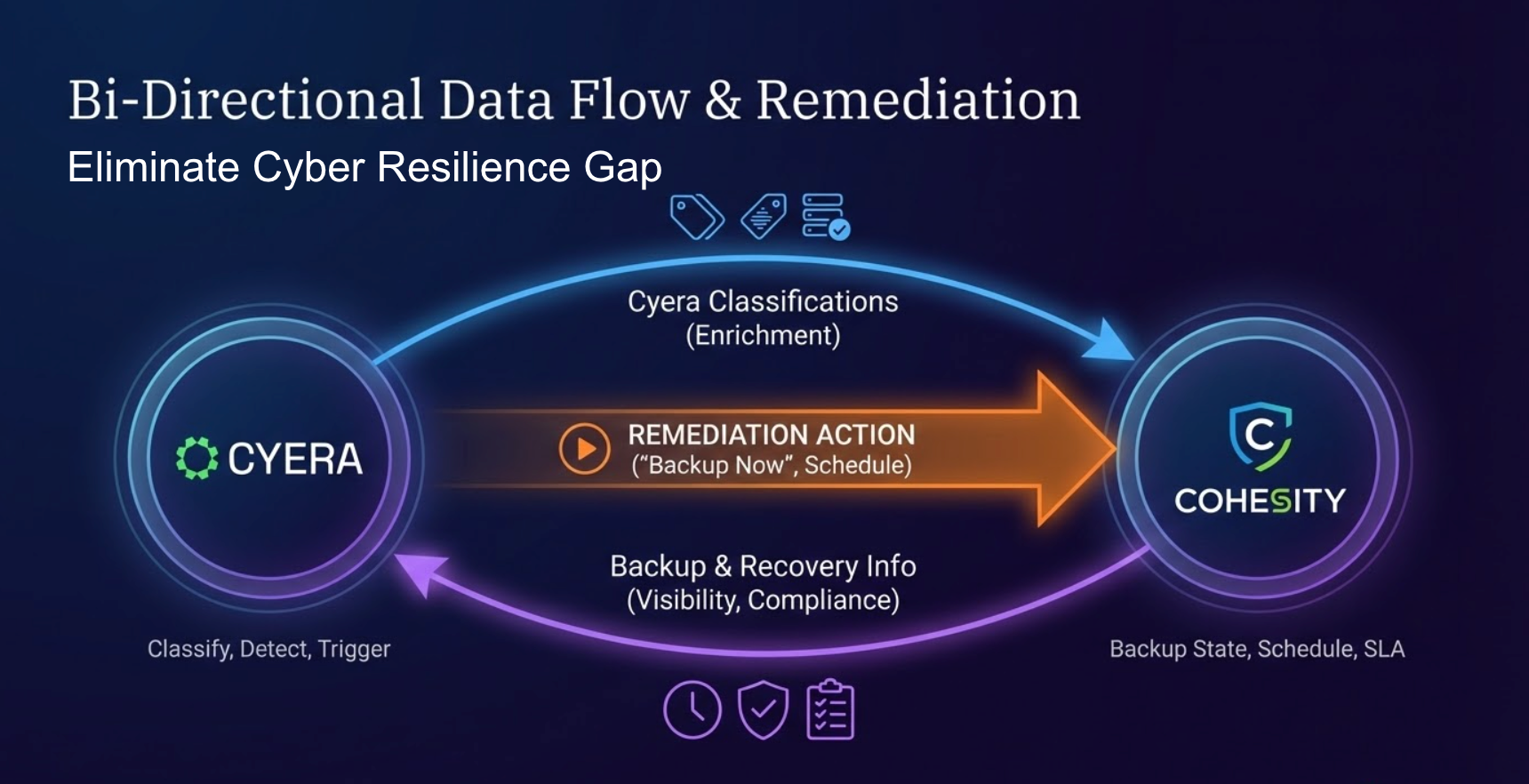
The power of bi-directional intelligence
The bi-directional integration provides organizations with the essential visibility needed to ensure sensitive data is always accounted for and recoverable.
This unified intelligence provides proactive value across every stage of the data security lifecycle:
- Before an attack: Organizations can proactively optimize their backup policies by aligning protection levels with data sensitivity. Real-time verification ensures that all critical assets have confirmed coverage, transforming protection from a manual check into a continuous, automated certainty.
- During an attack: Incident response is significantly streamlined through a unified view of data sensitivity and backup status. Security teams can instantly assess the blast radius and determine recovery options from a single pane of glass, accelerating decision-making when every second counts.
- After an attack: Recovery becomes a strategic and prioritized process. By utilizing data sensitivity context, teams can ensure that the most critical and restricted assets are restored first, minimizing business disruption and ensuring the fastest return to normal operations for high-value data. Backup teams can also maintain compliance by ensuring data is only recovered to compliant locations.
What each flow enables in practice
DSPM tags in Cohesity Security Center
Cyera imports its data classes and categories from its deep data intelligence, and uses the Cohesity Create Tag, Tags Actions, and List Tags APIs to write sensitivity labels directly onto resources in Cohesity. Backup administrators see the sensitivity classification of each protected object, — Restricted, Confidential, or otherwise — and can adjust protection policies without needing to context-switch into a separate security tool.
This makes it straightforward to prioritize immutable backups and encryption for restricted or confidential data, and to stop protecting low-value datastores that don't warrant the cost.

Protection gaps surfaced as risks in Cyera
By reading Cohesity's resource list and protection status back into the platform, Cyera can now flag sensitive datastores that fall outside Cohesity's backup coverage as explicit risks. These appear alongside other data security findings, prioritized, actionable, and tied to specific assets, so security teams don't need to correlate two separate reports to find the exposure. Cyera platform showing sensitive data with no backup protection

How the integration works end to end
Step 1: Cyera scans and classifies Cyera discovers and classifies every datastore (cloud, SaaS, on-premises), and tags each one with its sensitivity level. This happens continuously, with classifications updated as data changes.
Step 2: Tags flow into Cohesity Cyera writes DSPM sensitivity tags to the corresponding Cohesity resources every 24 hours. The Cohesity Security Center reflects the current classification state for all protected objects, supporting all Cohesity-compatible resource types.
Step 3: Protection status flows into Cyera Cyera reads back the protection status of each resource via Cohesity's Object Search API. Sensitive datastores with no backup coverage appear as risks in Cyera, visible, prioritized, and ready to act on.
Step 4: Teams act with context Backup teams tighten coverage on sensitive assets and remove unnecessary protection from low-risk data. Security teams close backup gaps on high-value datastores. When incidents happen, response teams have both data sensitivity and recovery context in one view, allowing them to identify blast radius fast and lead recovery with the right priorities.
What this unlocks for your team
For security teams: backup gaps on sensitive data are now a first-class risk signal inside Cyera. No more manual cross-referencing. No more discovering after an incident that your most sensitive datastores were never in scope.
For backup and IT teams: the Cohesity Security Center now shows sensitivity context without requiring access to a separate platform. Protection policies can be built around actual data risk, not assumptions, which both tightens security and reduces unnecessary backup spend.
For incident response: when an attack happens, the combination of Cyera's classification and Cohesity's protection view lets you identify which sensitive data was in the blast radius, which of it is recoverable, and what to restore first. That context is the difference between a structured recovery and a chaotic one.
Get started
The bi-directional integration is generally available for Cyera customers with Cohesity deployments. Setup requires generating an API token in the Cohesity Helios console; the Cyera team handles the rest.
- Book a demo to see both flows in action in your environment.
- Learn more about the Cyera and Cohesity partnership.

Get your AI Security Assessment
.jpg)
.jpg)

.svg)