What is AI Security?
AI Data Security starts with understanding that data is the vector – and the weakness – in most AI strategies. Protecting that data requires control across the entire AI lifecycle.
AI is transforming how organizations operate, compete, and innovate. With this transformation comes a new kind of exposure: your organization’s data. Every model, copilot, and AI agent depends on data, and visibility into how that data is being used becomes crucial to enabling secure AI usage.
AI Security is the practice of protecting the data that powers, trains, and interacts with AI systems. It ensures that sensitive information remains governed, compliant, and secure across every AI workflow. At its core, AI Data Security means discovering, isolating, and sanitizing data before it enters AI models or tools, so your copilots and large language models (LLMs) can operate safely and responsibly.
Traditional security models focus on networks, endpoints, or applications. Cyera redefines AI security as data-centric, giving enterprises visibility into what data AI is using, how it moves, and who or what has access.
What are the core pillars of AI Data Security?
AI Data Security starts with understanding that data is the vector – and the weakness – in most AI strategies. Protecting that data requires control across the entire AI lifecycle.
1. AI data discovery and classification
Accelerate AI Readiness by identifying and classifying sensitive data before it’s ingested by copilots or models. An AI-SPM solution automatically detects personal, financial, or regulated data types and assigns sensitivity labels for secure AI use.
Why this matters: Roughly 40% of organizations have reported at lest one AI-related privacy incident, and a full 87% believe that they don’t have proper visibility into how AI touches their data. This means that AI-realted privacy incidents are only going to increase without proper AI security measures in place.
2. Contextual access control
Prevent unauthorized or overly permissive access by managing how AI systems interact with sensitive data. Cyera provides visibility into who (or what) is accessing AI data, whether it’s a human user, a copilot, or an autonomous agent, and governs it based on trust context.
Why this matters: It’s been reported that 78% of organizations feel that controlling access and permissions for non-human identities is a top concern. AI data security platforms help you create a least privileged, risk adaptive approach to securing AI tools.
3. Risk assessment and policy enforcement
Cyera’s AI Data Security Platform continuously evaluates the risk of exposing sensitive data to AI systems and automatically enforces policies to reduce it. The platform identifies high-risk data that should never enter copilots or models, protecting against data leaks and compliance violations.
Why this matters: The average cost of a data breach reached $4.88 million this year. That figure has consistently risen for the past several years. With the rapid adoption of AI, coupled with the lack of clear and focused AI security policies, enterprise attack surfaces are getting larger at an exponential rate. Having AI security policies in place isn’t enough, you need a platform capable of peforming risk assessments and policy enforcement in real time.
4. Continuous monitoring and visibility
Maintain oversight of where AI data resides, how it’s used, and who interacts with it. AI tools interact with your data in real time. Traditional, static security tools simply weren’t design to combat this type of access. Having continuous visibility across environments and the ability to detect changes or anomalies is paramount to prevent risk escalation.
Why this matters: According to a survey of 461 security professionals, only 17% of organizations have automated AI Security controls in place. This makes in nearly impossible to securely enable AI tools from accessing sensitive private data.
5. Data and access convergence
Cyera’s data + access brain unifies DSPM, DLP, and access intelligence, giving organizations the context needed to secure data at the speed of AI. This convergence allows you to understand risk in real time and orchestrate response across your ecosystem.
Why this matters: The statistics cited above show that as AI adoption continues to accelerate, the exposure of sensitive data is growing at an equally alarming rate. A holistic AI-native approach is the only way to keep pace with threats and to properly secure AI.
Download the latest research
Cyera Labs has compiled a comprehensive AI Adoption Report that is essential reading for any data security professional. Download the guide below, or you can find other AI Security resources by clicking here.

.avif)
What are the most common AI Security threats?
AI introduces a new risk dynamic: autonomous systems interacting with sensitive data at scale. The following are the most common AI data security threats organizations face today.
Shadow AI and unbounded access
Teams experimenting with copilots or third-party AI tools can inadvertently expose sensitive data. Without AI Visibility, organizations cannot track what data is being accessed or shared.
Data leakage via prompts and outputs
Unsecured prompts and responses can cause sensitive information, like customer data or IP, to be revealed to external systems or unintended users. Cyera identifies that exposure by ensuring proper classification and access control.
Over-permissive AI agents
When copilots or AI tools inherit user permissions, they often gain far broader access than necessary. Cyera helps limit exposure by continuously assessing access risk and identifying AI tools that can see sensitive data they shouldn’t.
Data poisoning and untrusted sources
AI models trained on unverified or unclassified data risk corrupting results or leaking regulated information. Cyera ensures data integrity through labeling, context, and policy enforcement before training or ingestion.
Compliance and accountability gaps
Legacy systems lack visibility into AI-driven data flows. Cyera bridges this gap by mapping where sensitive data moves across AI environments and ensuring alignment with compliance frameworks like NIST AI RMF and ISO/IEC 42001.
How AI Security differs from traditional cybersecurity
Traditional cybersecurity protects infrastructure. Securing AI usage requires protecting data-in-motion, the sensitive information powering AI ecosystems.
Traditional Cybersecurity
AI Security
Focuses on networks, endpoints, and devices
Focuses on data and access across copilots, models, and AI agents
Defends against external threats
Defends against internal misuse and ungoverned AI behavior
Uses rule-based control
Uses contextual, risk-based understanding of data interactions
AI requires an evolved approach to data protection. With DSPM for AI and AI-SPM, Cyera delivers unified visibility and governance over the data and identities AI systems rely on. The result is a data-aware, adaptive security model built for AI scale.
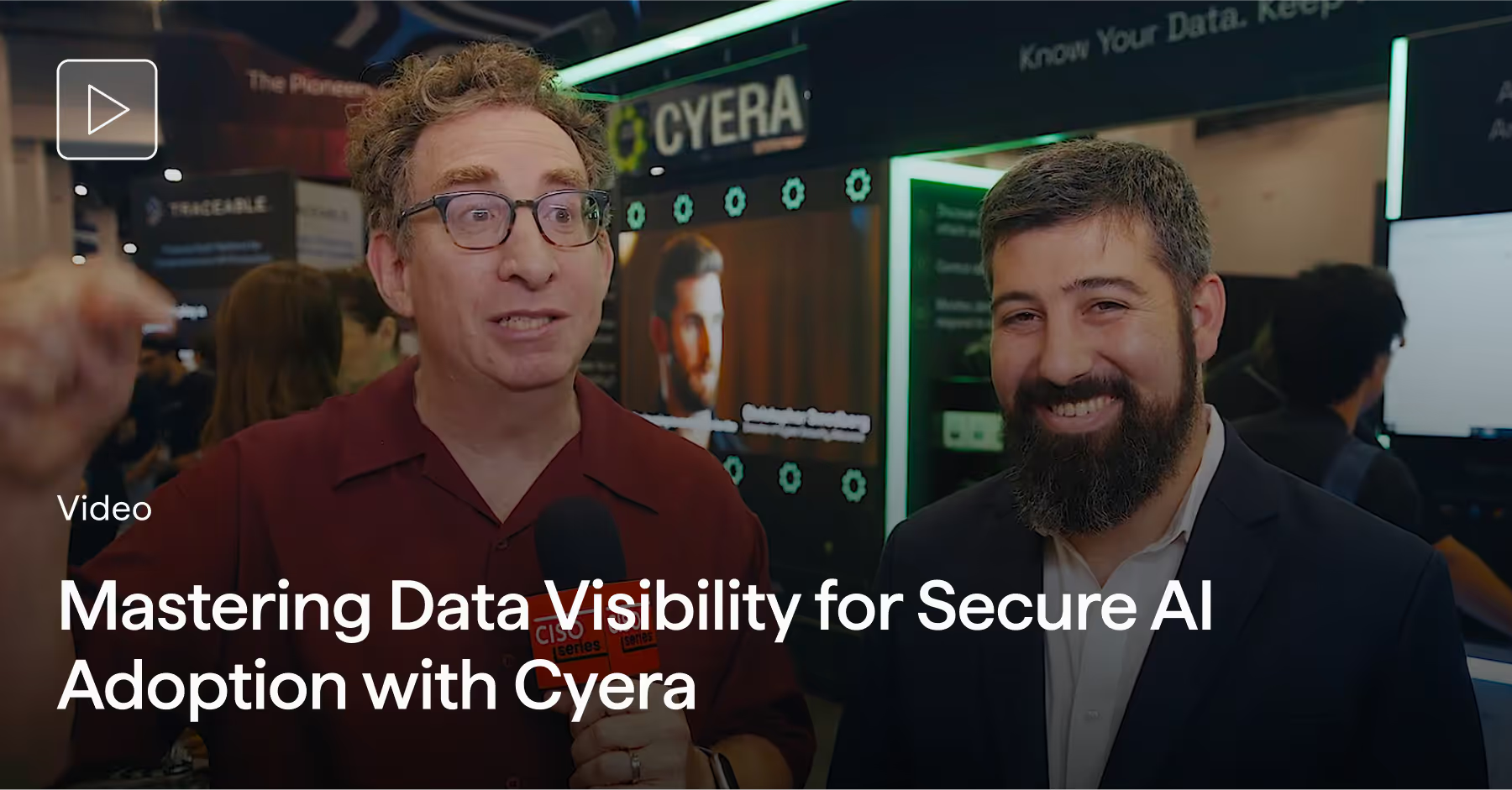
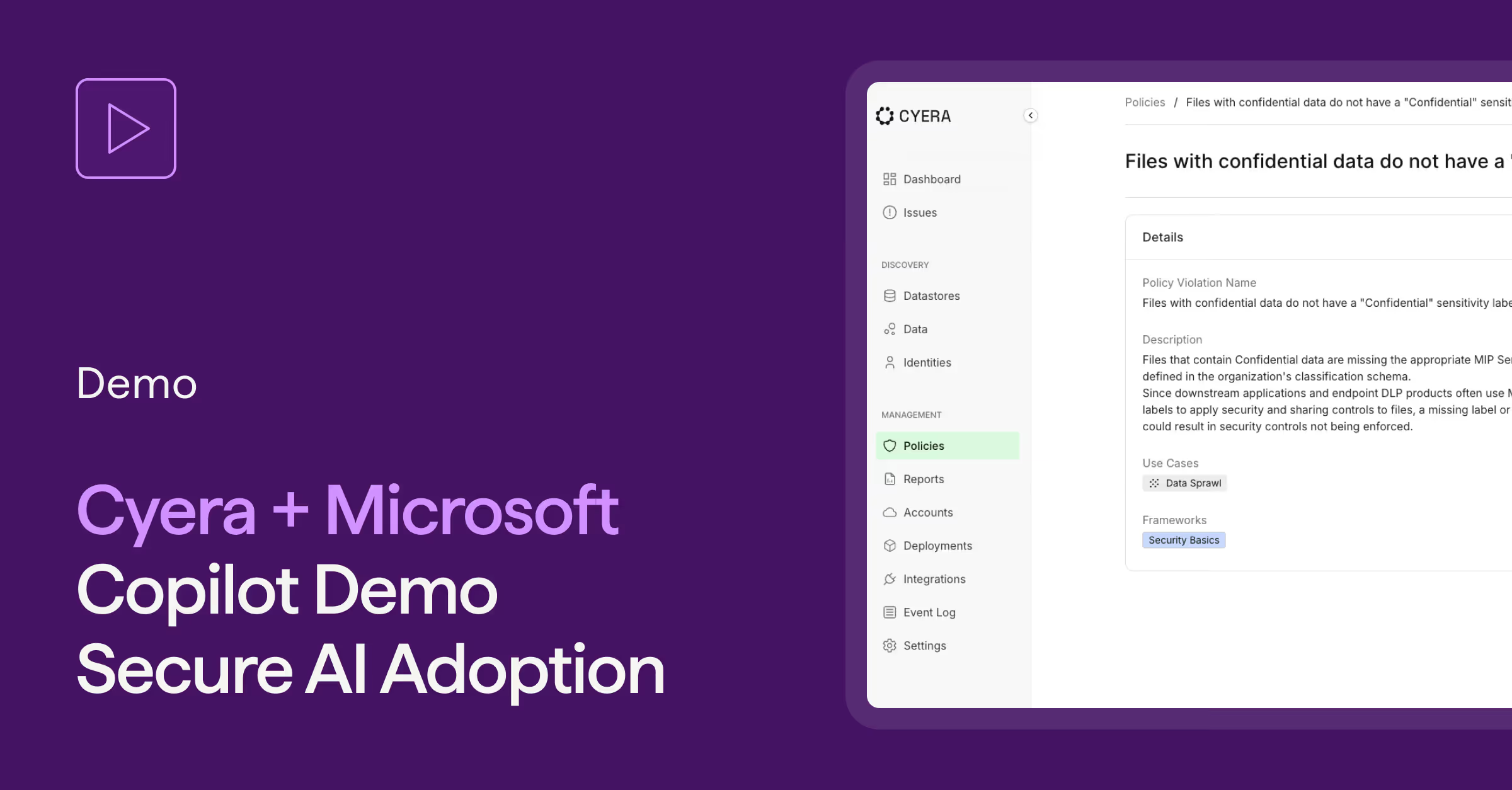
Watch: Secure AI adoption in action
Learn how Cyera empowers organizations to adopt AI securely. Hear from security leaders and see Cyera’s AI-SPM in action.
Introducing Cyera AI Guardian
Building a secure AI lifecycle
A secure AI lifecycle integrates protection into every stage, from data acquisition to model deployment and decommissioning.
- Discover: Locate and classify all data across cloud and on-prem environment used by AI systems with AI Discovery. The goal is to understand what data exists, where it resides, and it’s sensitivity level.
- Prepare: Sanitize and label data to ensure copilots and models use it safely. This ensures that only approved, high-quality data enters the AI pipeline.
- Train: Control which data enters AI training sets and apply privacy-preserving techniques. This helps to ensure the confidentiality and integrity of both your data and models.
- Deploy: Enforce data policies and access guardrails for production environments. Now you are ready to prevent unauthorized access to model outputs and underlying data.
- Monitor: Continuously assess data risk and detect anomalies. AI acts in real-time, so your AI Security Lifecyle needs to respond in kind.
- Retire: Securely archive or delete data once it’s no longer needed by AI systems. This not only minimizes data, but helps to assure regulatory compliance.
Every stage is powered by Cyera’s visibility and automation, ensuring that AI adoption remains secure, compliant, and data-driven.
How to Implement an AI Security strategy
Building an effective AI security strategy starts with understanding where your data lives and how AI interacts with it.
Assess your AI posture
Identify which copilots, models, and tools access sensitive data.
Establish policy controls
Define what data can be used by AI, where, and by whom
Deploy AI-specific protections
Implement AI-SPM and DSPM to manage data risk across environments.
Integrate with DevOps pipelines
Embed data security into AI workflows early to prevent leaks later.
Monitor continuously
Use real-time insights to detect drift, over-permissioning, or shadow AI activity.
Cyera enables each of these steps with an AI-native platform that combines discovery, risk analysis, and automated enforcement, giving you both visibility and control.
Featured insights on AI Data Security
Stay ahead of the latest AI security trends, insights, and research from Cyera’s experts. Explore how data, access, and AI are converging, and what it means for your enterprise


Future-proofing your AI Security
AI is evolving faster than traditional controls can manage; future-proofing requires a dynamic, adaptive, and data-centric foundation:
- Converge data and access intelligence to keep pace with agentic AI behavior.
- Automate detection and mitigation of AI data risks in real time.
- Maintain compliance alignment as new AI regulations emerge.
- Extend visibility across third-party copilots and AI ecosystems.
Cyera’s vision, a unified data and access brain, gives security teams the context and control they need to safely embrace AI innovation at scale.
FAQ

.svg)