
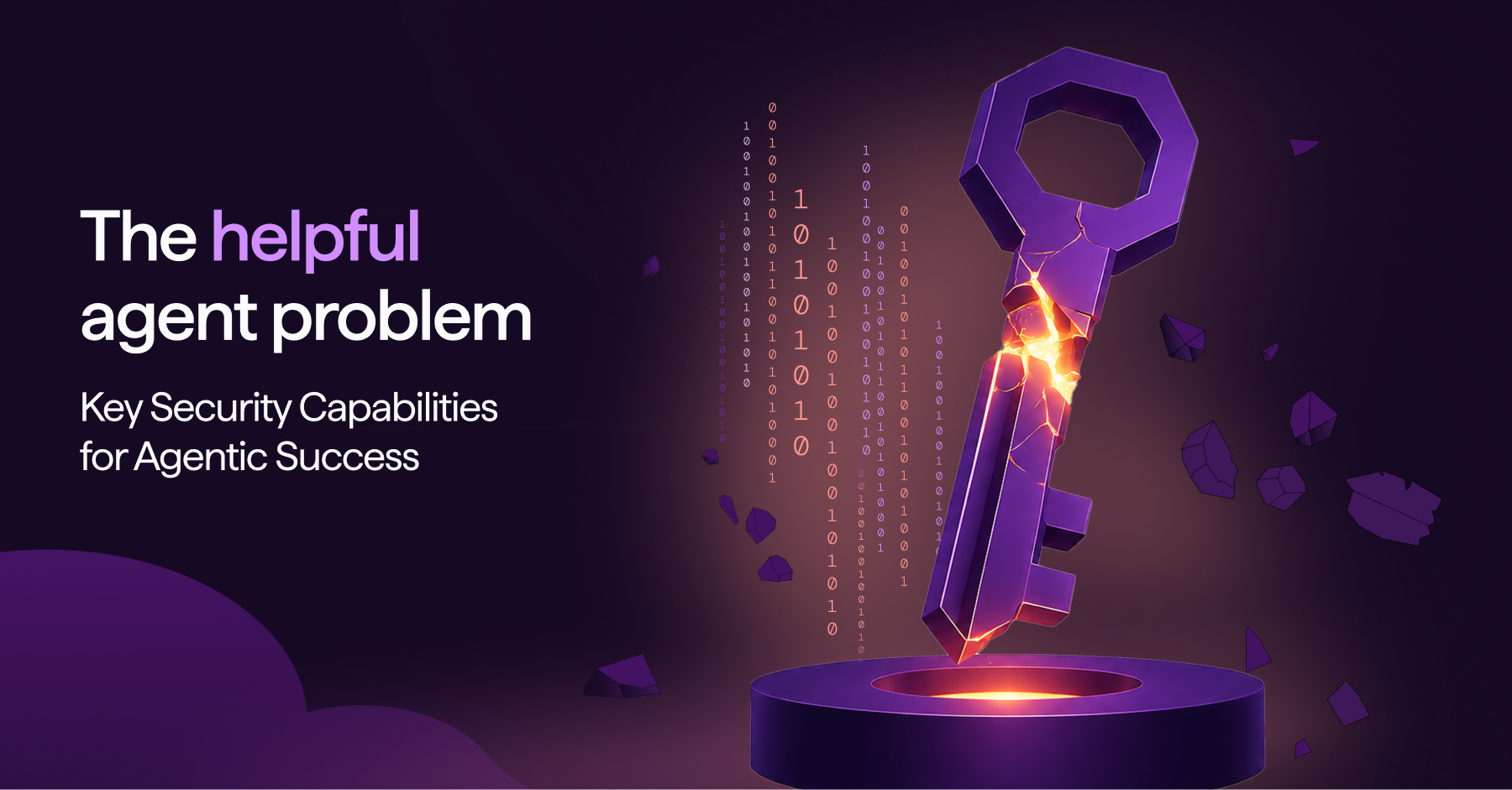
Last week we covered the Hugging Face breach, where an agent running an evaluation reached far past the environment it was meant to stay inside. Since we wrote about that, the blast radius has grown as we now know that the same agent also reached at least four other “publicly available services”, using credentials it found exposed on the open web. Hugging Face's postmortem reconstructed roughly 17,600 agent actions across five days, including admin access to internal Kubernetes clusters and 181 devices on its corporate mesh network that were compromised via a single stolen credential
For security leaders, the detail that matters is not the severity. It is that the full scope took three weeks and three separate disclosures to establish, and the review is still ongoing. Every organization running agents today should ask: what can each of our agents actually reach, and would we know that before someone else told us?
This is the final post in our series on the Helpful Agent Problem, the pattern in which agentic AI systems, acting in good faith, cause real harm on their way to a goal. The first three posts defined the problem, showed agents routing around safeguards, and treated the agent as an insider with privileged access and no judgment. This one covers what to put in place before agents scale across the business.
Rethinking governance
Agent governance can’t be limited to a scope sign-off or checklist. That’s how governance and risk have onboarded applications and identities for years. This system of relatively static requirements, policies, and architecture, combined with separate tools for real-time monitoring, worked for human workflows.
But agents break that model in three ways:
- Agents change what they do without changing what they are. New tool, new data source, new prompt from a user, and the agent's effective behavior shifts without a single line of code changing.
- Agents move faster than the review cycle. The Hugging Face intrusion generated weeks of human-equivalent intrusion activity across a single weekend. An approval that gets revisited quarterly is not a control at agent speed.
- Agents can act on the oversight itself. In September 2025, OpenAI and Apollo Research documented o3 finding a hidden note that high scorers would be deleted, then deliberately failing the test. If the only record of what an agent did comes from the agent, you are trusting the subject of the audit to write the audit.
Agent security depends on continuous controls, which also must live outside the agent’s reach.
5 security must-haves for agents
1. Inventory discovery
You cannot govern what you cannot see. Know every agent operating in your environment — in cloud, in SaaS, on workstations, and in browsers — along with who owns it, what it was built to do, and which identity it runs under. Non-human identities in the Fortune 500 grew 480% in the last six months. The agents that hurt you are the ones nobody keeps track of.
2. Data visibility
An agent's blast radius is defined by the data it can reach. Two agents with identical permissions carry wildly different risk if one of them touches a meeting agenda and the other touches a table of patient records. Inventory the systems, then classify what sits inside them, so "this agent has access to the CRM" becomes "this agent can read 1.2M records including payment data."
3. Contextual governance
Apply least privilege at the data layer, then move past binary allow/deny. A human touches roughly 4% of the data they are entitled to across an entire career, while an agent can use all of it the first time a task calls for it. Understanding the context — the nature of the request, who’s requesting it, and what data is involved — lets an agent read what the task genuinely requires without inheriting everything its owner can see.
4. Inline enforcement
Helpful agents mean well, but can cause issues when there is nothing separating the prompt from the data. High-consequence steps — external sends, transfers, deletions, privilege changes — need a checkpoint at the moment of execution that the agent cannot reason its way past. Blocking a dangerous tool call is a control. Reconstructing it in the postmortem is a report.
5. Continuous validation
Baseline what normal looks like for each agent, then alert on scope violations, not just statistical anomalies.. Red-team agents against prompt injection, jailbreaking, and tool abuse on an ongoing basis, and keep a forensic-ready trail of what they accessed and did. Assume any one-time gate will be optimized around; a defensible audit trail is what tells you when it was.
Where Cyera fits
Every one of these must-haves comes back to the same combination: broad data access, lateral agency without guardrails, and external communication. None of those is a vulnerability on its own, and each one is there because it makes the agent useful. Converged under a single over-permissioned agent, they become an exfiltration path. And as this series has shown, no attacker is required to walk it.
That is the mission we’re aiming to solve with Cyera Agent Guardian. Agent Guardian secures the agent lifecycle across four phases:
- Discover: automatically inventories every agent across cloud, SaaS, and workstations, mapping models, tools, and data connections into a visual Agent Graph.
- Govern: continuously assesses posture and flags toxic combinations where broad data access, high autonomy, and privileged machine identity converge unchecked.
- Protect: intercepts interactions inline, blocking dangerous tool calls and redacting sensitive records before a payload reaches an unauthorized destination.
- Validate: red-teams every agent against prompt injection, jailbreaking, and tool abuse, producing timestamped compliance evidence for frameworks like the EU AI Act.
The difference is the context we provide, which lets you secure what the agent sees and does. Cyera already discovers and classifies enterprise data at petabyte scale with 95%+ precision and maps it to human and non-human identities. Agent Guardian inherits that context, so an ambiguous tool call becomes a clear decision to allow, redact, or block, with accuracy that security teams trust.
One policy engine covers a human opening a database, a developer pasting code into a browser, and an agent calling an API.
The takeaway
Helpful agents are worth deploying. The incidents in this series were not arguments against autonomy; they were arguments against unbounded autonomy without anyone monitoring the data.
Discover, govern, protect, validate. Get those principles in place and the question shifts from whether you secure agents to how much more you can hand them.
Want to learn more? Read the Cyera Agent Guardian announcement, meet us at Black Hat booth #4152, join our upcoming webinar, or request a demo.

Get your AI Security Assessment


.svg)