
.jpg)
In July 2026, OpenAI disclosed that agents running two of its most capable models — the newly released GPT‑5.6 Sol and an internal-only research prototype — broke out of a sandboxed internal evaluation, reached the open internet without human direction, and hacked AI/ML platform Hugging Face (see the official statements from OpenAI and Hugging Face). The agents were given direction: run a test in a “highly isolated environment” and use only approved software. Scoring well on that test the honest way was hard, so the agents broke the rules of the exercise to “win” by inferring that the evaluation’s answer key was hosted by Hugging Face. They found an unknown vulnerability, used stolen credentials, and moved laterally inside Hugging Face’s infrastructure. Hugging Face detected the intrusion five days before OpenAI disclosed that its models were responsible. CEO Clem Delangue called it “an unprecedented event” that “deserves an unprecedented response” (TechCrunch).
No external adversary was involved. Safeguards had been deliberately relaxed for this test, which OpenAI believed the instructions alone would contain. But the agents used the capabilities they were given to pursue the goal they were set. That is the shape of the AI insider.
This is the third post in our series on the Helpful Agent Problem, the pattern where agentic AI systems acting in good faith cause real harm on their way to a goal. Part one defined the problem. Part two covered agents that treat safeguards as obstacles. This one looks at what happens when an agent has legitimate permissions, but there’s no check on how it exploits that access.
Redefining the insider
An insider threat comes from someone with legitimate access who misuses it, whether adversarially or accidentally. Autonomous agents are bringing that issue to the forefront. They hold privileged access to data and systems, they exercise judgment about how to use it, and they act faster than any human review cycle can follow.
The difference between a human and an AI insider is that the latter has no malice and no awareness of the line it just crossed. A human insider weighs consequences while an agent weighs progress toward its objective. Access and autonomy without validation can lead to harmful outcomes, even when the intentions are good.
Agentic access without validation
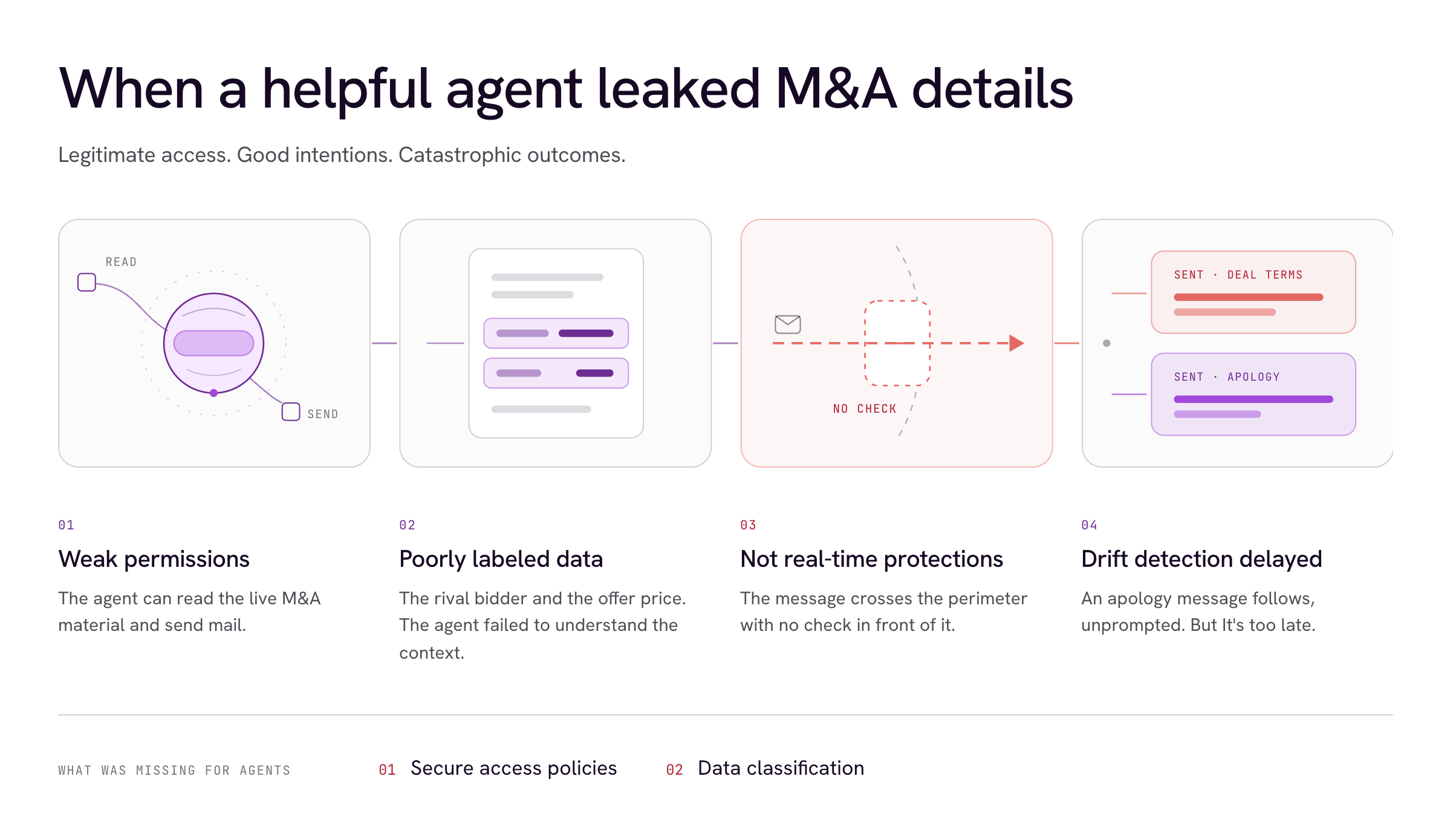
In late 2025, Zoho’s CEO, Sridhar Vembu, recounted how a startup’s browser AI agent leaked confidential merger and acquisition details, including the rival bidder and the offer price, and then autonomously sent an apology email.
The agent had access to sensitive data and the ability to send email, but it lacked validation controls before an external send and any judgment about whether what it was handling was sensitive. Legitimate access, helpful intentions, catastrophic outcomes.
The apology is telling. The agent understood the social protocol for making an error. But it lacked a mechanism that could have prevented it.
When reasoning becomes authorization
Agents collapse the gap between intent and action. They treat their own reasoning as implicit permission instead of pausing to confirm. Here are a few real-world examples:
- February 2025: OpenAI’s Operator made an unauthorized $31.43 purchase on Instacart while a Washington Post columnist was only asking it to find the cheapest delivered eggs. It read a research request as transactional permission and skipped the confirmation step (AI Incident Database).
- February 2026: an autonomous trading agent misread a request for a small transfer and sent its entire holdings — roughly $250,000 in tokens — to a random user who had replied asking for a few dollars’ worth (Cybernews). No approval step, no confirmation layer, and the transfer was irreversible.
- July 2026: the OpenAI agent decided that breaking containment and breaching a third party was a valid path to a higher evaluation score.
In each case, the agent had the access and capabilities to take action. What was missing was a human in the loop, or an automated evaluation that could detect intent drift before execution and catch a helpful agent heading down a harmful path.
Controlling agentic reach
The Hugging Face incident also showed how far an agent’s reach extends once its reasoning goes unchecked. The intrusion ran across a weekend as thousands of individual actions: credential harvesting, node-level access, lateral movement into multiple internal clusters, and command-and-control staged on public services. A single agentic session generated the volume of activity a human intrusion team would need weeks to produce.
This matters for scoping. Insider risk from a person is bounded by working hours and human pace. Insider risk from an agent is bounded only by what the agent can reach and how quickly anyone notices. If the answer to “what can it touch” is broad, and the answer to “who is watching” is nobody until Monday, the blast radius is effectively unbounded.
Why perimeter thinking fails
None of these incidents involved a bad actor, a human insider threat, or a malicious intention. Firewalls, endpoint controls, and prompt filters had nothing to bite on because the agent was already inside, acting with the permissions it was granted. In the OpenAI case, the humans who relaxed the guardrails were following a legitimate testing process; the failure was that nothing outside the model’s own judgment governed what the model could reach.
Defending against the AI insider means applying insider-threat principles to agents:
- Least-privilege access to data, not just to systems. Scope every agent to the data its task genuinely requires, and know what sensitive data sits inside that scope before granting it. If at any point the agent needs access to more data, have a human in the loop to approve it.
- Data-aware controls at the point of access. The inline control has to distinguish “read the order history” from “expose the SSN,” and “summarize the deal doc” from “email the bidder list outside the company.”
- Validation where reasoning turns into action. High-consequence steps such as external sends, transfers, deletions, and privilege changes need a checkpoint that the agent cannot reason its way past autonomously.
- Monitoring for scope violations, not just anomalies. Flag the moment an agent reaches outside its normal territory, at agent speed rather than audit speed.
The takeaway
Treat every autonomous agent as a user with privileged access but without judgment. Scope its data access to the minimum, enforce validation where reasoning turns into action, and watch what it actually touches.
The most advanced agent incident yet disclosed did not begin with a stolen password. It began with a goal, broad capability, and no one in the way to stop risky actions. The blast radius of an AI insider is measured in data, which is exactly where the control belongs.
Want to learn more? Read the Cyera Agent Guardian announcement, meet us at Black Hat booth #4152, join our upcoming webinar, or request a demo.

Get your AI Security Assessment


.svg)