

Securing AI in the enterprise follows a natural progression: first you see what's happening, then you prevent what shouldn't. Cyera and Anthropic took the first step with our integration with Claude's Compliance API, which gives security teams full visibility into Claude Enterprise: which conversations touched sensitive data, who was involved, and when.
Today we're taking the second step. Anthropic's new inference hooks give every Claude Enterprise organization a real enforcement checkpoint: every prompt routes to an AI security API endpoint first, gets back an allow or deny, and only then does the model see it. Cyera Agent Guardian now sits behind that hook, bringing visibility and prevention from the same integration partnership.
Agent Guardian already delivers preventative controls at your AI gateway, on employee devices, and inside the browser, giving you enforcement wherever your workforce meets AI, including Claude. Inference hooks add a new kind of control point to that set: one that runs on Anthropic's cloud side. You enforce policy centrally, from one configuration, and coverage reaches every Claude Enterprise user the moment you turn it on. No new agent to deploy for this path, no traffic to reroute, just one connection covering Claude Chat, Claude Cowork, Claude Code, and Claude Design at once.
And because Cyera's classification engine already knows what your data is, who owns it, and who's allowed to touch it, the verdict at that checkpoint isn't a guess. It's grounded in your data.
Stop sensitive prompts before Claude answers
When your organization turns on Claude's inference hooks, every prompt sent to Claude Chat, Claude Cowork, Claude Code, and Claude Design routes through Agent Guardian before the model runs.
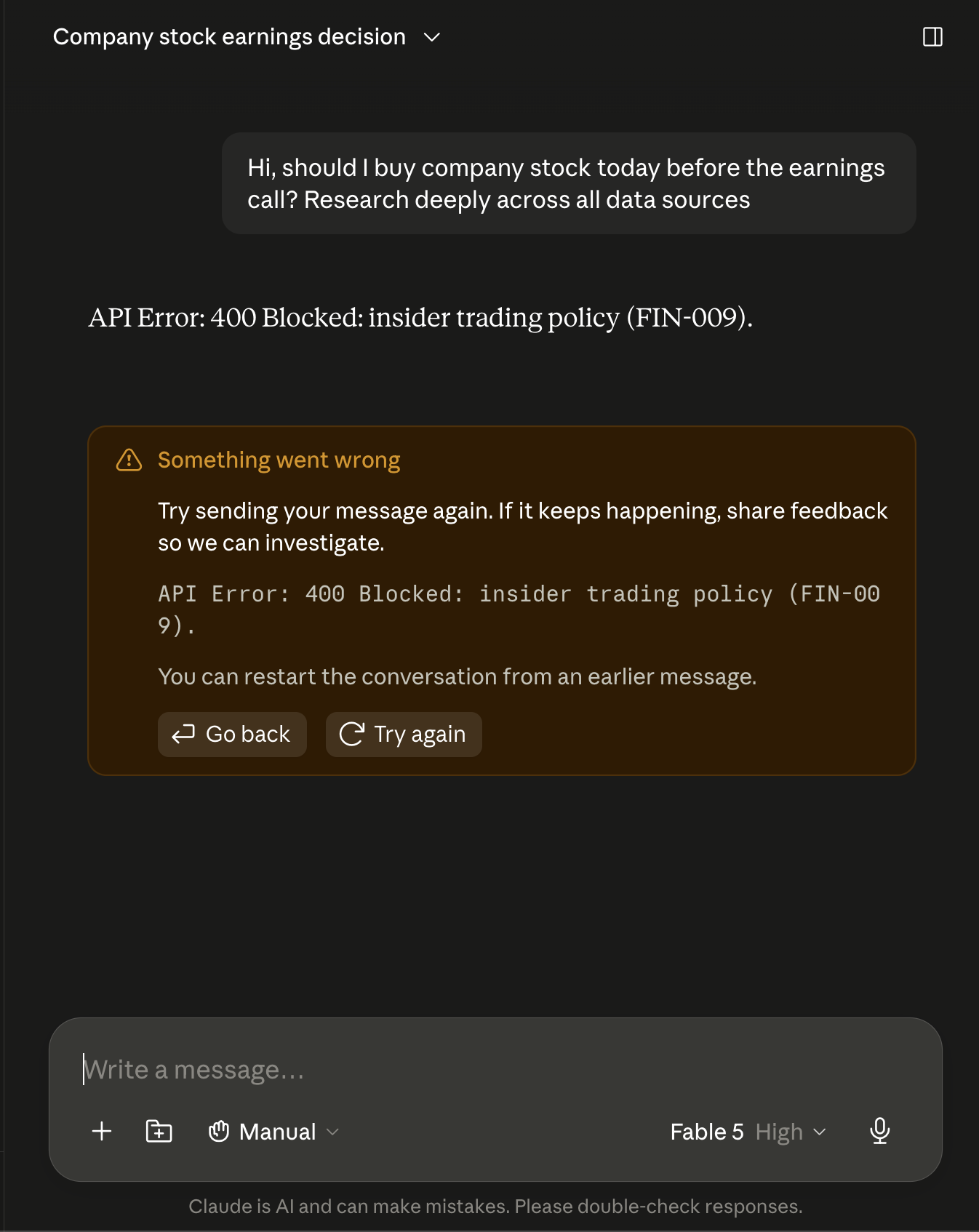
Before Claude answers, it hands Agent Guardian the conversation: the prompt, any tool calls and their results from earlier in the session, and text pulled from attached files. Raw files, images, and system prompts never leave Claude's side. Agent Guardian confirms the request is genuinely from Anthropic, checks the transcript against your data policies, and returns a verdict, allow or deny, inside Anthropic's five-second default window.
Allow, and the conversation continues as normal. Deny, and the prompt never reaches Claude. The user sees why, and the block lands in the Agent Guardian alerts view the same way a PII data leakage policy violation would.
Judge prompts by what's actually sensitive
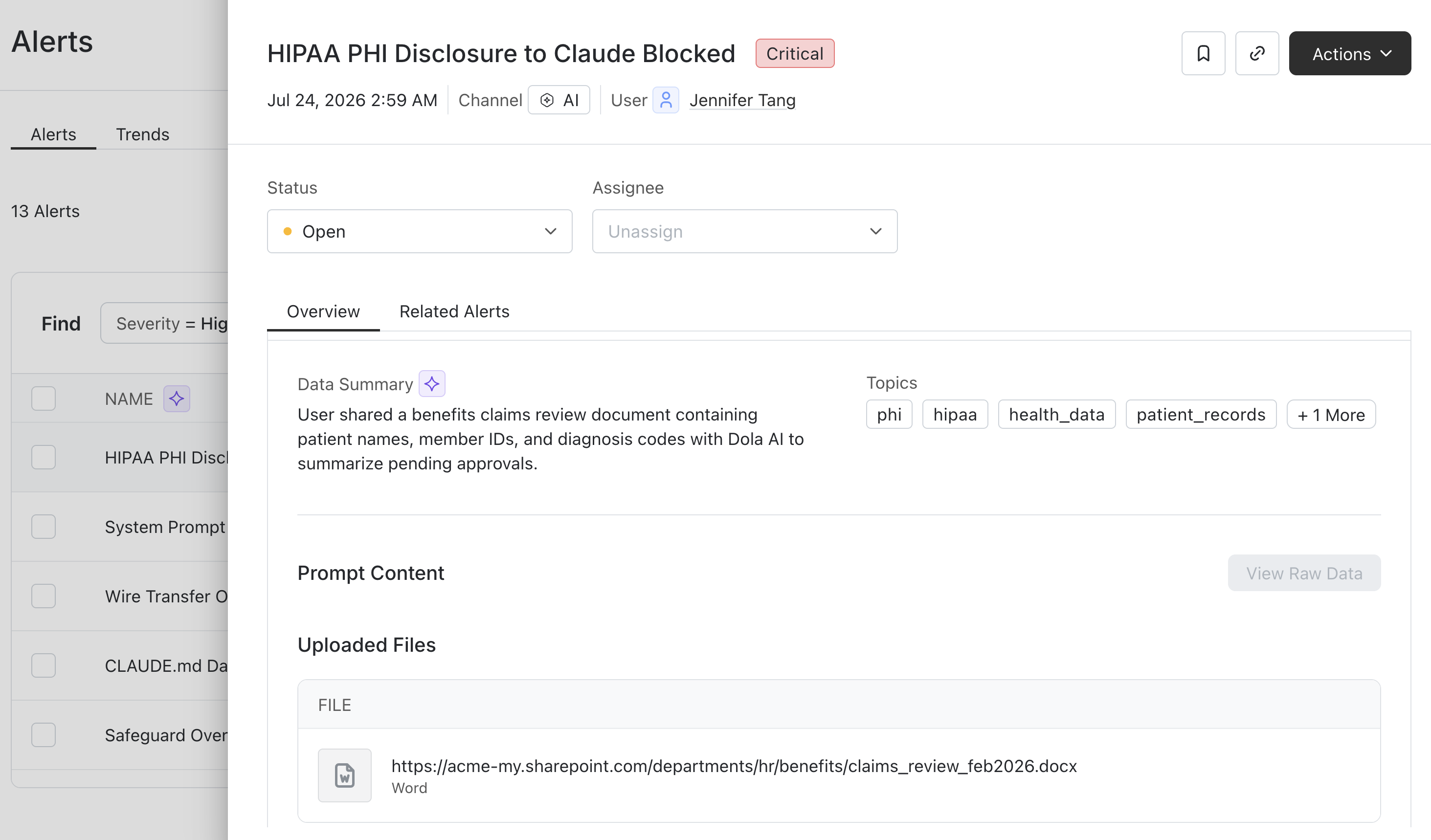
A deny verdict is only as good as what's behind it. Wire a generic scanner into the same hook and you get a faster filter, not a smarter decision. Agent Guardian checks the prompt against data Cyera has already classified, at petabyte scale, with sensitivity, lineage, and ownership attached. The same forecast, the same patient record, the same source file carries its risk score into Claude.
The record behind the words. Two sessions can reach what looks like the same spreadsheet excerpt, whether someone pastes it into Claude or Claude Cowork opens the file on its own mid-task. One file is a quarterly forecast still under embargo. The other is a public earnings summary from six months ago. Agent Guardian tells them apart because it classified both before either ever reached Claude.
Entitlement changes the answer. The same request can be routine for one person and a violation for another. A member of the legal team pulling case files with PII is doing their job. Someone outside that group attempting the same pull gets a different verdict, because Agent Guardian checks the request against who's asking, not only what's in it.
Govern every Claude surface, on your terms
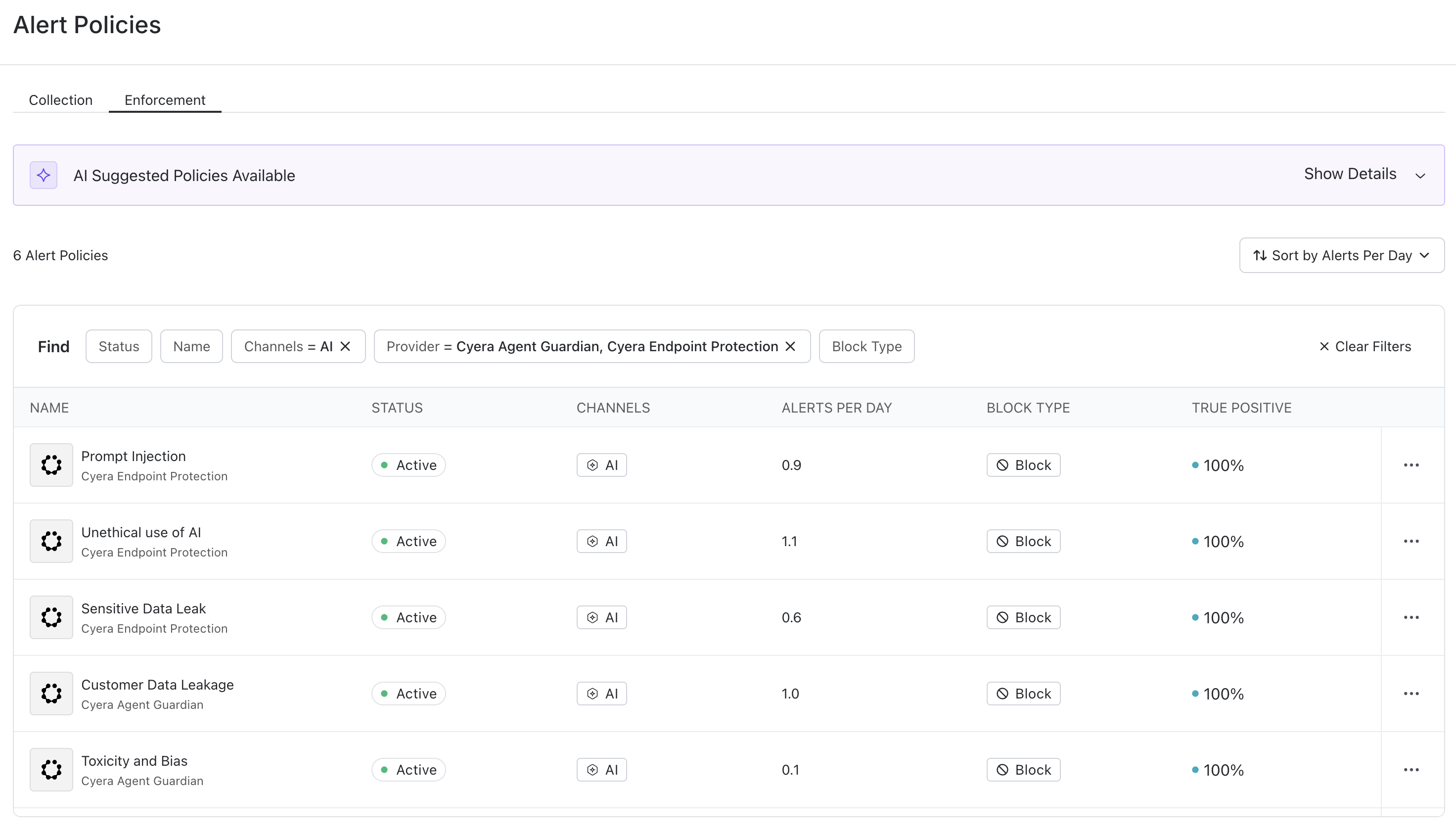
Claude Enterprise already has options: an AI gateway if traffic routes through it, Cyera Endpoint if it's deployed. Inference hooks add a third, with nothing to deploy.
Inference hooks cover Claude Chat, Claude Cowork, Claude Code, and Claude Design from the same connection. One policy applies whether someone's chatting, running Cowork, or executing code: no sharing customer PII outside approved regions, no production credentials pasted into a prompt reaches the model. That's one rule, not three consoles. And because the checkpoint lives inside Anthropic's own infrastructure, it covers a Claude Code session on a personal laptop the same way it covers one on a managed device. That matters, because an unmanaged laptop is exactly where a policy gap used to hide.
You control the pace, too. Anthropic built rollout controls into the hook itself: shadow mode watches verdicts on live traffic without blocking anything, a percentage-based rollout inspects a slice of requests while you tune policy, and role-based exclusions cover teams you're not ready to govern yet. Even failure handling is yours to set. If a verdict ever runs long, the hook follows your rule: block by default so nothing slips through unchecked, or allow through where uptime matters more. You decide what "safe" means for each part of your environment.
From visibility to prevention
The Claude Compliance API gave you the record: what touched sensitive data, who, and when. Inference hooks add the checkpoint in front of it. Because it lives on Anthropic's cloud side, you get preventative control across every Claude surface without deploying anything to the workforce. With Agent Guardian behind that hook, it's a live gate that knows what it's blocking, and why, before it blocks it.
To see how Agent Guardian evaluates a prompt against your own data before it reaches Claude, book a personalized demo today.

Get your AI Security Assessment
.jpg)

.svg)