An HR business partner has a planning meeting on Friday. She asks Claude to turn a spreadsheet export into a clean dashboard: headcount by team, open roles, and compensation bands. Twenty minutes later she has something better than she would have built by hand.
The source data included individual salaries and performance ratings, and some of that detail carried into the dashboard. She needs a recruiting partner outside the company to weigh in, so she sets the dashboard to "anyone with the link" and pastes the URL into an email.
Nobody did anything malicious. She used a sanctioned tool, did good work, and shared it the fastest way available. But the security team may not know that sensitive employee data is now accessible to anyone with the link.In July 2026, Axios reported that some publicly shared Claude artifacts, including business plans, infrastructure diagrams, and clinical trial planning documents, had turned up in Google search results, so a link meant for one person could be found by people its owner never had in mind.
That gap is what Cyera's newest coverage addresses. Cyera is extending Agent Guardian and Data Security coverage to Claude Artifacts in Claude Enterprise. By classifying sensitive data in supported artifacts and showing their sharing context, Cyera helps security teams understand where sensitive information may be accessible beyond its intended scope. The capability is now in Private Preview for Cyera customers.
What Claude Artifacts are, and why they matter for data and AI security
Claude Artifacts are the docs, slides, dashboards, designs, and apps that people create with Claude. Instead of copying an answer out of a chat, a user gets a finished piece of work they can keep, refine, and share.
Adoption has been fast. Being easy to keep and share is what makes artifacts useful, and it is also what makes them a new home for sensitive data. People build artifacts from the material they work with every day, such as customer lists, financials, HR records, and source code. Owners can share an artifact with specific people, the whole organization, or anyone with the link. At that volume, even a small share of artifacts that hold sensitive data and are shared more broadly than intended can add up to meaningful exposure, and that exposure grows as adoption does.
As artifacts become a normal part of how teams work, security, privacy, and AI governance leaders need answers to two simple questions. What sensitive data is in our artifacts? And who can reach it?
What Cyera covers
Setup builds on what Cyera customers already have in place. Cyera uses read-only access via the Claude Compliance API connection Agent Guardian already uses , so no additional permissions are needed.
Cyera organizes artifacts by the Claude user who owns them, so teams can see sensitive data in the context of its owner. Artifacts published by agent sessions, which have no user owner in Claude, are grouped separately, so they stay visible too.
Coverage includes Docs, Slides, Dashboards, Designs, Motion, and code artifacts such as apps and websites. Sheets and Whiteboards aren't supported. Cyera scans the latest version of each artifact. Chats, messages, and files uploaded to chats aren't scanned as artifacts; Agent Guardian covers those through its separate Claude Enterprise deployment coverage.
From finding to owner review: how the workflow comes together
Go back to the dashboard. Here is how a security team would see it with artifact scanning in place.
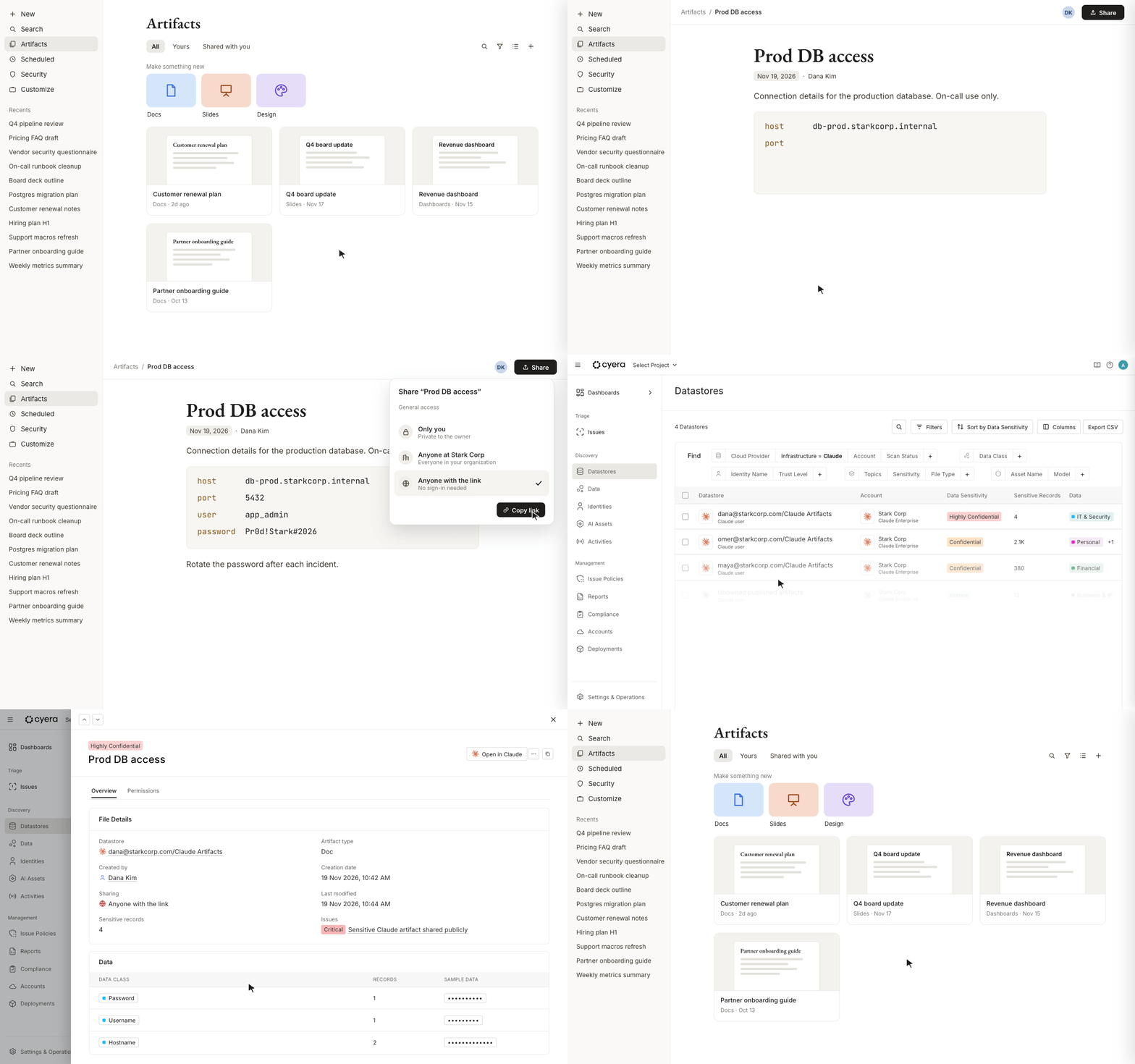
Understand what's inside. Cyera classifies the data in each supported artifact and shows its classifications and sensitive data findings. If the dashboard contains sensitive employee data, Cyera can classify it and show it alongside the dashboard's sharing context.
See who can reach it. By default, only the owner can access a new artifact. Cyera reads each artifact's sharing level at every scan and shows who can access it: the owner alone, the owner plus the groups it's shared with, everyone in the organization, or anyone with the link, without signing in to Claude. People invited by name are counted rather than listed individually.
Know which sharing raises an issue. Cyera policies raise an issue when an artifact that holds sensitive data is public, meaning shared with anyone who has the link, or external, meaning shared with someone outside your Claude organization, such as a person invited by email who isn't a member. Sharing with everyone in your organization isn't considered external. It appears as access context, so the team can judge whether broad internal visibility suits that data.
Give the owner a direct path to review. Each issue shows the artifact, its owner, and its sensitive data, and includes an Open in Claude link. The owner can use that link to review the artifact and change its sharing in Claude. In our example, the HR partner could limit the dashboard to specific people and share a version without individual salaries. The decision, and the change, stay with the person who knows the work.
See it in context. Each user's artifacts are also added as a data source in the Agent Graph, alongside the rest of the AI activity Agent Guardian maps.
Why sensitivity plus access is the right lens
Sensitive data isn't a problem on its own. Your teams need to work with customer, financial, and employee data, and AI makes that work faster. Broad sharing isn't a problem on its own either; an org-wide launch plan is exactly what sharing is for.
Risk comes from the combination: sensitive data in a place more people can reach than intended. Classification alone produces noise, and sharing settings alone miss what matters. Seeing both together lets a team focus on the artifacts that need attention and leave everyone else to keep building.
That balance is central to secure AI adoption. Security teams don't want to slow down the people getting the most out of Claude. They want clear visibility, a short list of real issues, and a direct path to the owner who can review them. Artifact scanning is built for that kind of visibility: security teams get the context, and owners get a clear next step in Claude.
After artifacts are processed, their data is analyzed and classified, and then deleted from the Data Analysis Service.
Availability
Claude Artifacts scanning is in Private Preview for Cyera customers using Claude Enterprise. If you'd like to bring your Claude Artifacts into view, contact your Cyera representative to request access.

Get your AI Security Assessment