

AI Agents are changing who and what can access sensitive data, what they can do with it, and how quickly risk can spread. Traditional security models were built around human users, static permissions, and after-the-fact detection. To secure agentic adoption, security needs to help determine what is possible before an action takes place.
That requires data and identity to be understood together. Identity tells you who or what is acting. Data tells you what is at stake. Cyera’s latest product innovations bring those signals into one platform, helping teams discover, investigate, govern, and act across the environments where AI operates.
Below, we’ll walk through five highlights:
- Oasis Security joins Cyera: Unite data and identity to govern agentic access.
- Learned Policies: Turn organization-specific risks into actionable policies.
- New in Cy: Understand risk faster and prioritize next steps with contextual answers.
- Omni DLP: Make noise reduction visible and policy changes easier to trust
- New integrations: Extend AI security context across the tools agents use.
- Snowflake Marketplace: Procure and deploy Cyera DSPM right from Snowflake Marketplace.
Oasis Security: Secure the identities behind the agentic enterprise
Non-human identities (NHIs) at Fortune 500 companies grew by nearly 500% in the first half of 2026, according to our joint research with the Cloud Security Alliance. In cloud-native organizations, NHIs already outnumber human identities by roughly 10x. Most have no clear owner, no expiration, and more access than the work requires.
That scale changes the access problem. Traditional IAM was built primarily for human users and static permissions, not for discovering and securing NHIs or governing agents that act across cloud environments, SaaS applications, data stores, and enterprise workflows.
Earlier this month, Cyera acquired Oasis Security to address that shift. Cyera secures data at enterprise scale. Oasis discovers and governs non-human identities across their lifecycle and provides Agentic Access Management to govern what AI agents can do, evaluating each agent’s intent and granting only the access needed for each task.
Together, Cyera and Oasis are building one platform that sees both who is acting and what is at stake. Access decisions can account for the identity making a request alongside the sensitivity, exposure, and business importance of the data involved. This helps ensure that every human, machine, and AI agent gets only the access its work requires.
For security teams, that means moving beyond identities and data as separate control points. They can evaluate the full relationship between an identity and the data it can access, then govern that relationship before an action takes place.
Existing Oasis customers will continue on Oasis Platform with no change to their deployment or support. The teams are already hard at work integrating Oasis into Cyera’s unified AI platform, and we’ll share more details in the coming months.
Learned Policies: Policies shaped by your business context
Consider a wearable technology company with sensor designs, patent materials, and product specifications across its environment. Cyera already classifies these materials as intellectual property. The harder question is which access creates risk: which departments need sensor designs, when external identities should reach patent materials, and whether AI agents should read product specifications.
Built-in policies cover common risks. Learned Policies build on that foundation by using Cyera’s business-specific classifications, Topics, Business Associations, identities, and access patterns, along with relevant web and accumulated customer-specific knowledge. This context helps uncover organization-specific risks that may otherwise go unnoticed and recommend targeted, high-signal Issue policies.
For the wearable technology company, a Learned Policy might identify sensor designs accessible to departments without a clear business need, recommend tighter controls on patent materials based on recent industry incidents, or flag AI agent access to product specifications that should remain outside agentic workflows.
.png)
Each recommendation is evaluated for relevance, uniqueness, and expected issue volume before creation. This helps teams expand coverage with policies shaped by what matters to their business, rather than adding more generic policies or unnecessary noise.
New in Cy: Ask in context. Act with context.
AI security investigations can stall before they start. Teams may have the signals they need, but not a clear view of what to ask or investigate first. They need to connect those signals quickly and know where to start.
Cy now includes out-of-the-box prompts for Agent Guardian that give teams an immediate starting point for assessing their AI security posture. The prompts help teams focus on questions such as:
- Which agents can access sensitive data, communicate externally, or interact with untrusted content?
- Which users are associated with those agents, and what is their level of trust?
- Which agents are unreviewed, drifting, dormant, or retaining unnecessary access?
- Which agents and unresolved AI issues require attention first?
- How do token consumption and AI security posture vary across agents and models?
.png)
Cy also understands the context of supported pages, so answers are grounded in relevant context and analysts do not have to restate the scope of an investigation. From a page showing sensitive files, they can ask, “Which external identities can access these files, and through which groups?” Cy surfaces the relevant people, locations, and access paths, helping teams quickly determine whether access is broader than intended.
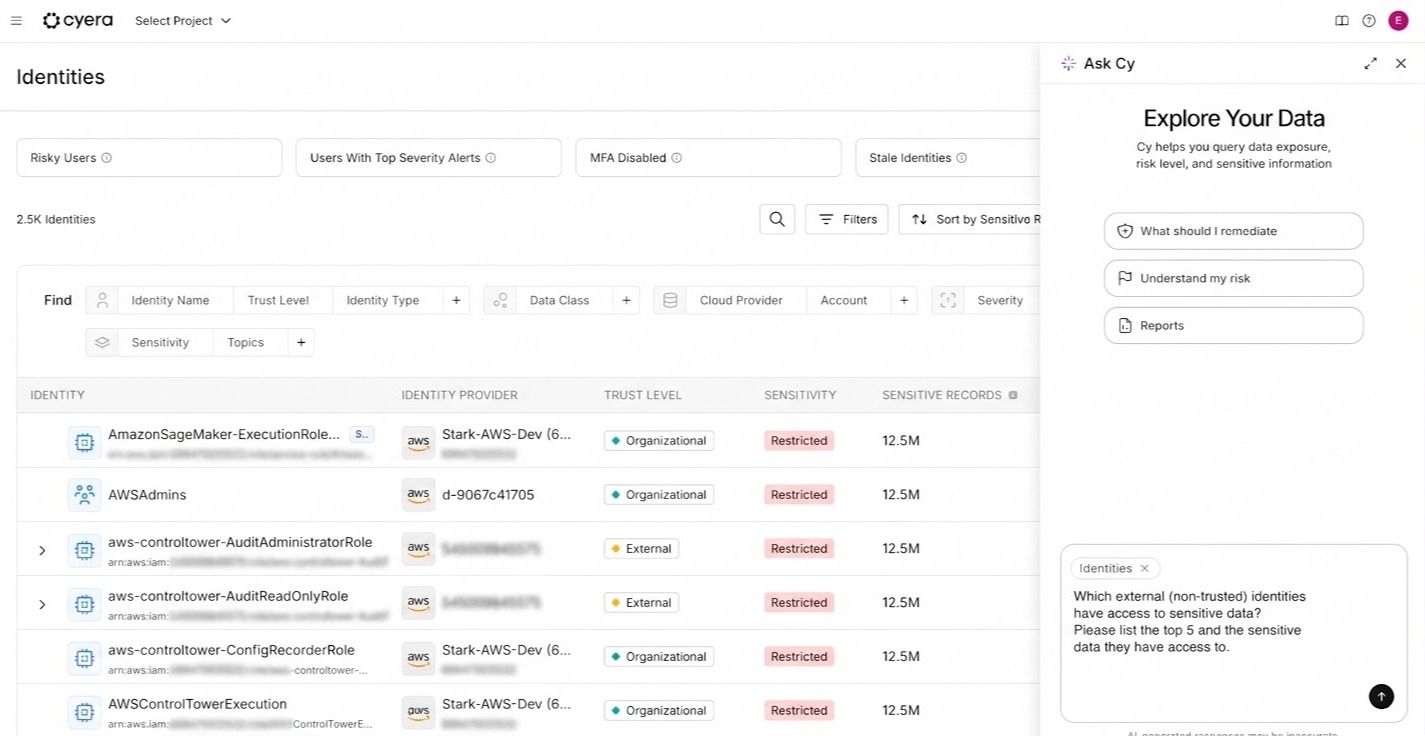
The result is a more direct path from understanding the AI landscape to identifying risk and deciding what to do next.
New in Omni DLP: Make noise reduction visible and policy changes easier to trust
As AI workflows multiply, sensitive data moves through more prompts, files, applications, and automated processes. Omni DLP now gives teams clearer signals and more control over how policies evolve:
- Noise Reduction Performance shows how much DLP activity Cyera analyzed, and how it classified that activity into true- and false-positive events. With that breakdown visible on the dashboard, teams can measure whether tuning efforts are improving signal quality and give analysts more confidence in what requires attention.
- In-Alert Recommendations let analysts review and apply a recommended role to a destination directly from an alert, without leaving the investigation. That added business context helps prioritize similar activity more accurately in the future, including sensitive data sharing involving AI tools.
- New Policy Creation gives teams a single, guided workflow to build policies from out-of-the-box templates across Cyera’s AI protection surfaces, including Workspace AI, Browser Shield, and Agent Guardian.
- Version Diff Control adds a color-coded comparison between consecutive policy versions, paired with performance metrics, so teams can assess the impact of each change and diagnose policy drift.
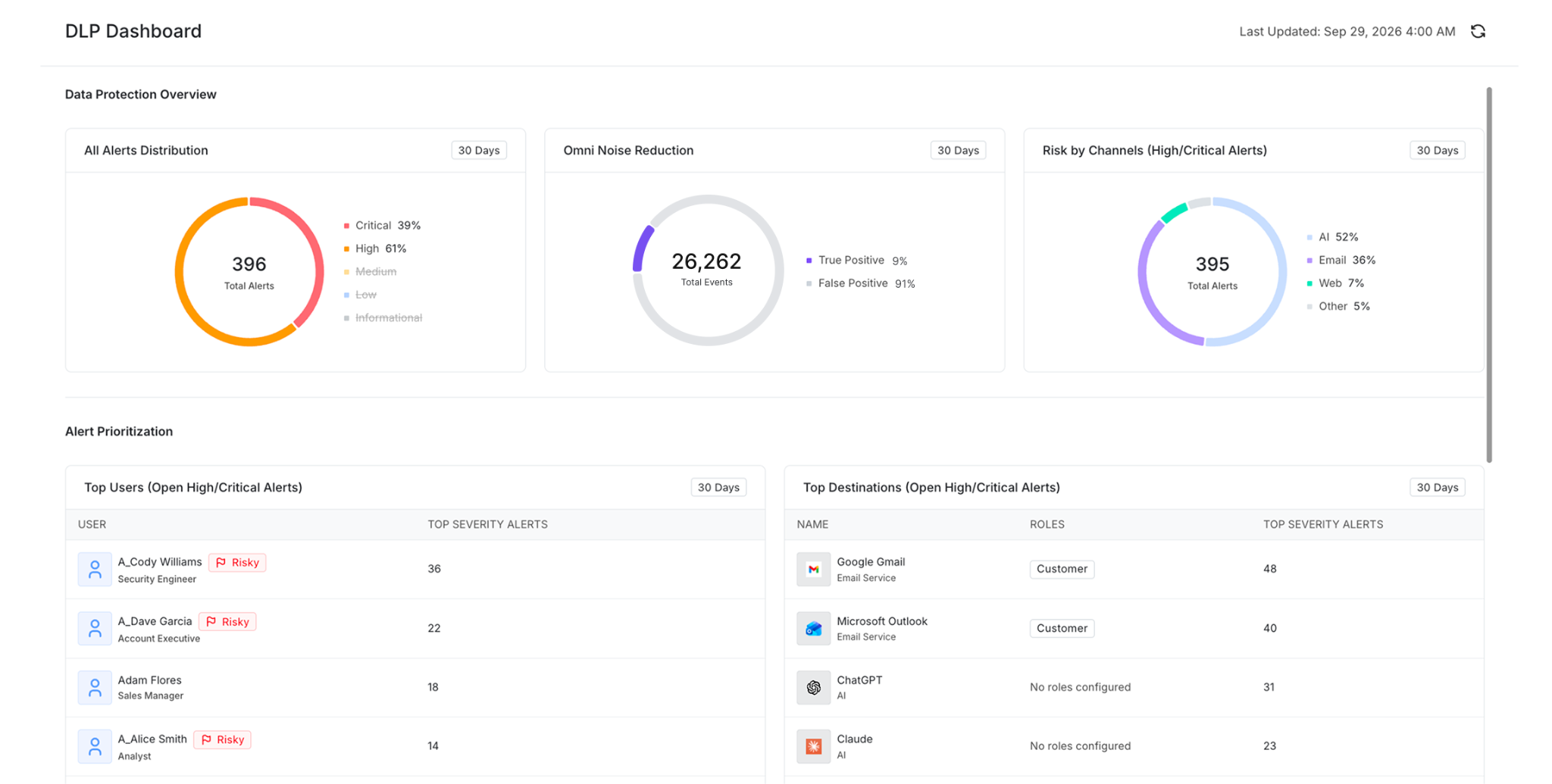
These enhancements make it easier to see what sensitive data is involved, where it is going, and which activity requires action. They also help teams keep DLP controls effective and explainable as AI usage expands.
Marketplace and integrations: Carry data intelligence and security context wherever agents reach
Snowflake customers can now procure Cyera through Snowflake Marketplace and apply existing committed capacity through the Marketplace Capacity Drawdown program, with no incremental budget required.
This partnership means customers can discover and classify sensitive data in Snowflake at exabyte scale with 95%+ precision, then govern what Cortex AI agents can access before shadow AI scales. Snowflake contains the data. Cortex agents represent the identities acting on it. Customers need visibility into both.
Additionally, three new integrations extend Cyera’s data context into adjacent security workflows:
- Gambit Security enriches resources and systems with Cyera’s sensitivity classifications, so recovery gaps involving AI-relevant data carry their real business and compliance impact.
- Rig Security enriches its identity access graph with Cyera’s classifications, helping teams see which identities can reach the most sensitive data.
- Twine Security enriches identity and remediation workflows with Cyera’s sensitivity, exposure, and risk context, helping teams prioritize governed, auditable action.

These partnerships help teams connect who or what is acting with the data at risk, even when AI workflows span multiple systems.
Build the foundation for secure AI
Agentic activity is reshaping how organizations need to uncover risk and protect sensitive data. Cyera brings together data, identity, and activity context so security teams can understand how humans, machines, and AI agents interact with sensitive data, prioritize meaningful risk, and control what happens next.
Watch the latest Landing video or book a demo to see how Cyera helps organizations secure AI with the context and controls to move forward confidently.

Get your AI Security Assessment

.svg)