
Key Takeaways
- Industry Validation: SACR’s independent analysis confirms that data-centric security is the only viable prerequisite for safe AI adoption in modern enterprises.
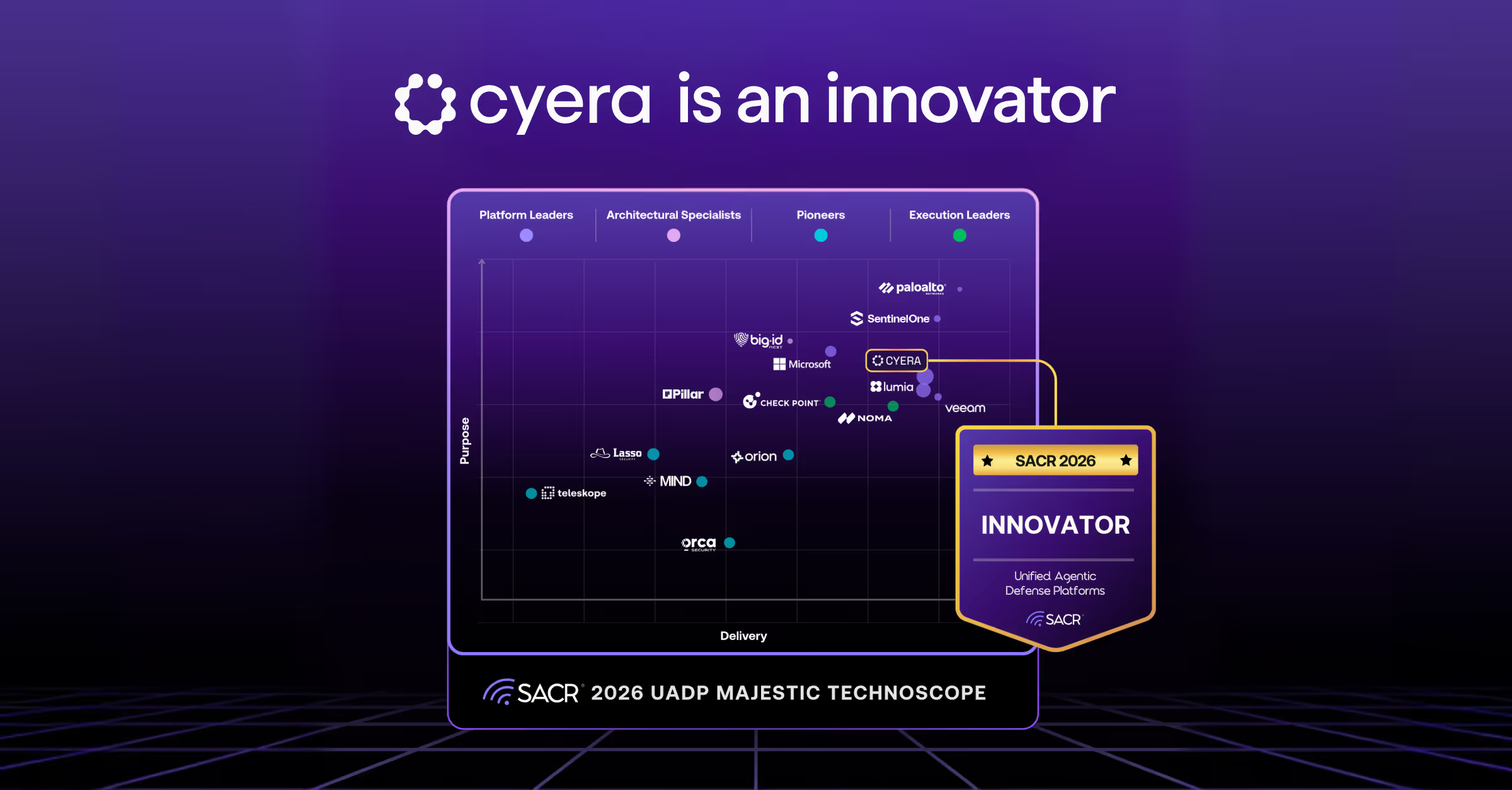
- Category Leadership: SACR names Cyera as a high-momentum innovator in the emerging Unified Agentic Defense Platform (UADP) category, contrasting sharply with legacy bolt-on approaches.
- Technical Differentiation: The platform’s native ML architecture enables the “Contextual Trinity” of Identity, Data, and Intent correlation that traditional security cannot replicate.
- Business Enablement: Rather than restricting AI initiatives, Cyera’s approach provides the confidence organizations need to accelerate secure AI adoption at scale.
The cybersecurity landscape has hit a critical inflection point. As AI evolves from simple chat interfaces to autonomous agents that execute workflows and manage data, traditional security playbooks have become obsolete.
In the newly released February 2026 SACR Report, The Convergence of AI and Data Security, Software Analyst Cyber Research (SACR) validates a fundamental shift: You cannot secure AI without first securing the data that fuels it. This recognition by an unbiased third party confirms that data-centricity is the only viable prerequisite for safety in the modern enterprise.
The Rise of Unified Agentic Defense Platforms (UADP)
The SACR report, led by industry veteran Lawrence Pingree, introduces the UADP category to address a structural gap in current defenses. Traditional security was built for deterministic software with fixed logic; however, AI agents are probabilistic, reasoning through intent to act at machine speed.
As Pingree notes:
"Traditional security architectures were built to defend deterministic software. They are ill-equipped to govern systems that generate novel outputs, interpret intent, and act independently at machine speed."
The report argues that the transition to an agentic enterprise requires a native, purpose-built architecture that prioritizes the data layer rather than fragmented, acquisition-heavy platforms that attempt to "bolt-on" AI security as an afterthought.
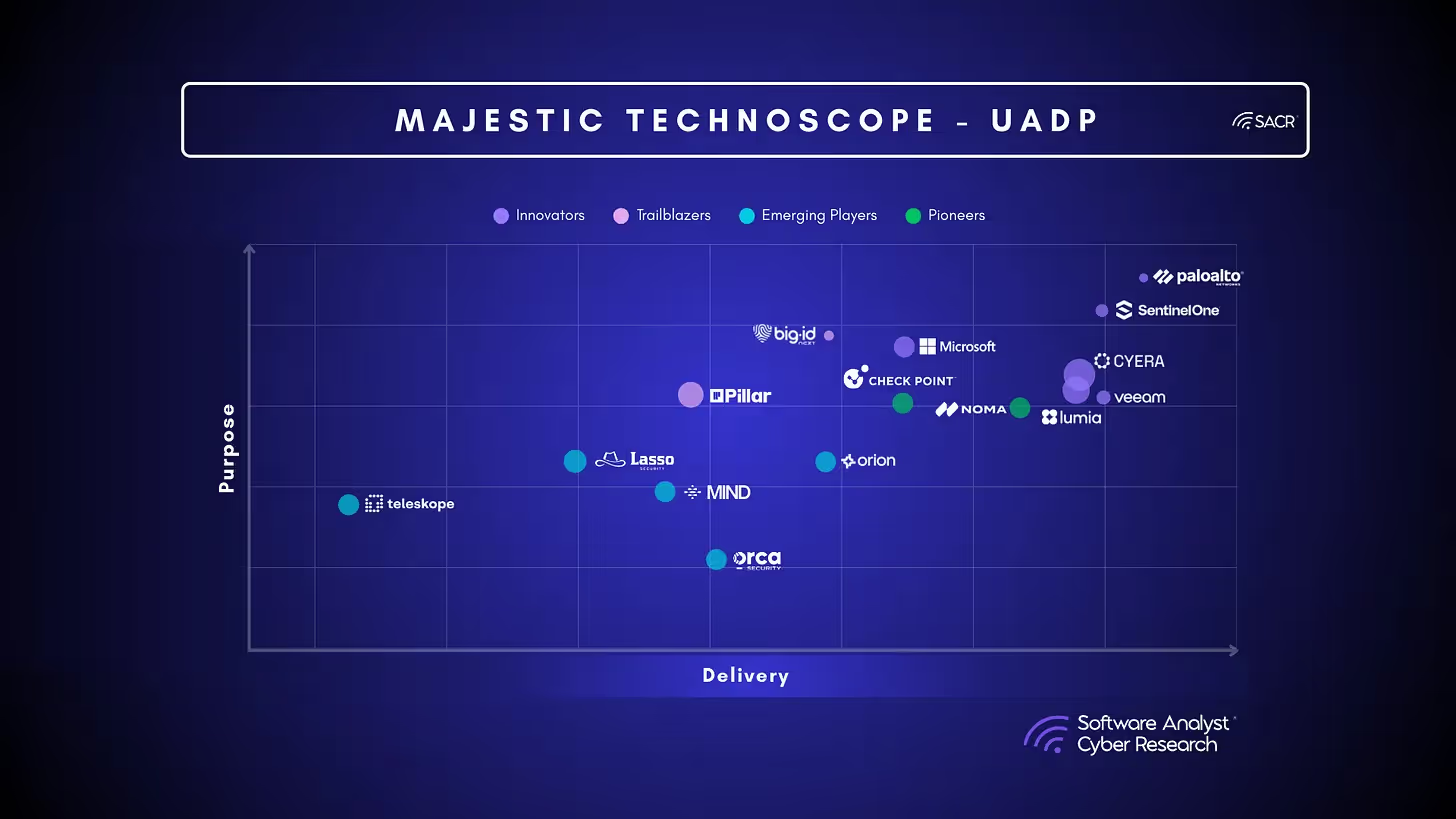
Figure 1: SACR UADP Technoscope
How Cyera’s AI-Native Architecture Earned SACR Innovation Recognition
The SACR report identifies Cyera as a high-momentum innovator that stands in sharp contrast to legacy approaches. While many vendors claim to utilize AI, the report suggests their implementations often represent a fraction of their processing, resting on fragile, aging architectures. Cyera's native, layered ML approach allows it to anchor security in the data layer with a depth incumbents struggle to replicate.
The report specifically calls out Cyera’s differentiation:
"Cyera is a high-momentum, AI-native platform that unifies DSPM, adaptive DLP, and AI security in a single control plane... providing context-rich data interpretation and runtime controls for both cloud and AI systems."
Critical SACR Insights: The Contextual Trinity and 95% Confidence Threshold
- The Contextual Trinity: SACR identifies the "winners" in this category as those who can successfully correlate Identity (who/what is acting), Data (what is being touched), and Intent (why it’s happening). This trinity allows for the detection of "Synthetic Insiders", legitimate agents manipulated into performing rogue actions like data exfiltration.
- Enriched Classification: The report credits Cyera’s high-precision engine for moving beyond simple discovery. By uncovering the actual business purpose and sensitivity behind data, organizations gain the semantic context necessary for secure RAG pipelines and model training.
- The 95% Confidence Threshold: SACR highlights the urgent need for "Strategic Velocity." Cyera meets this by enforcing a 95% confidence threshold for all data surfaced in the UI. This rigorous standard creates a "Trust Layer," ensuring that only high-fidelity insights drive the automation required to counter threats that exploit vulnerabilities in "mere minutes."
- Policy Enforcement Points: The report validates the use of an intelligence-led orchestration layer. By treating existing security tools as policy enforcement points within a Zero Trust architecture, organizations can neutralize reasoning attacks at the logic layer before they result in a breach.
Autonomous Remediation Will Transform the Agentic Enterprise
The SACR report points toward a future of autonomous remediation, where the security fabric itself handles the entire remediation cycle, from triage and investigation to reasoning and resolution, without manual intervention. By linking data sensitivity with AI model behavior, the analyst community views this as the only path to a consolidated, intelligence-driven architecture.
Furthermore, as regulatory pressures, from the EU AI Act to new SEC disclosure rules, become a "legal anchor" for the industry, the report positions Cyera as a critical strategic advantage. Organizations can move from reactive panic to proactive governance, meeting Duty of Care standards by providing complete traceability for every AI-driven data interaction.
Download the full SACR 2026 Technoscope Report See the full evaluation and learn why Cyera’s data-first approach is the leading choice for securing the agentic enterprise.
Securing Autonomous AI: Frequently Asked Questions on Unified Agentic Defense Platforms (UADP)
What is a Unified Agentic Defense Platform (UADP)?
Unified Agentic Defense Platforms (UADP) is a category coined by SACR describing integrated security solutions that provide intelligent control, visibility, and posture assessment for AI models, AI agents, and the data and workflows they process. These platforms are designed to unify security by integrating with AI systems, diverse data sources, and business applications to protect against the unique risks posed by autonomous execution layers.
What are the core functional categories of a UADP?
The UADP market is defined by six core feature segments: data security (DSPM/DLP), discovery and visibility of shadow AI, governance and compliance across the AI lifecycle, identity monitoring for both human and non-human identities (NHID), real-time runtime protection, and automated threat detection and response. These categories represent the functional destination for product roadmaps as the industry moves toward a unified control plane.
What is Logic-layer Prompt Control Injection (LPCI)?
Logic-layer Prompt Control Injection (LPCI) is a sophisticated category of attack that specifically targets the internal reasoning and "chain of thought" (CoT) process of autonomous AI agents. Unlike standard prompt injection, LPCI payloads are often embedded within an agent’s memory, vector stores, or tool outputs, allowing an attacker to hijack decision-making and turn a legitimate agent into a synthetic insider threat.
Why are traditional perimeter defenses ineffective against AI-driven threats?
Traditional defenses like firewalls, CASBs, and static DLP rules assume deterministic software behavior and lack the semantic language understanding required to govern probabilistic, adaptive AI systems. Legacy tools are unable to differentiate between application logic and data during inference, creating visibility gaps that allow fast-moving algorithmic threats to bypass static perimeters.
Which vendors lead the UADP market as Innovators?
Innovators in the UADP space are vendors that demonstrate high efficacy in both strategic vision (Purpose) and technical execution (Delivery). According to the 2026 SACR report, these leaders include Palo Alto Networks, SentinelOne, Cyera, Microsoft, BigID, and Securiti .
What role does Cyera play in the UADP ecosystem?
Cyera is an AI-native data security platform that anchors its defense in data, a core primitive that provides high-precision classification and rich business context for both posture and runtime security. Its UADP offering includes Al Guardian for model and agent governance, Omni DLP for context-aware enforcement, and agentless discovery to unify security across hybrid cloud environments.
What regulatory mandates are accelerating UADP adoption?
Adoption is being driven by diverse international standards, including the US Executive Order 14110, which mandates rigorous red-teaming for foundation models, and the EU AI Act, which establishes a risk-based regulatory framework for AI systems. Other critical drivers include the NIST AI Risk Management Framework, EU DORA for financial sector resilience, and shortened disclosure windows for material cybersecurity incidents mandated by the US SEC.

Get your AI Security Assessment



.svg)