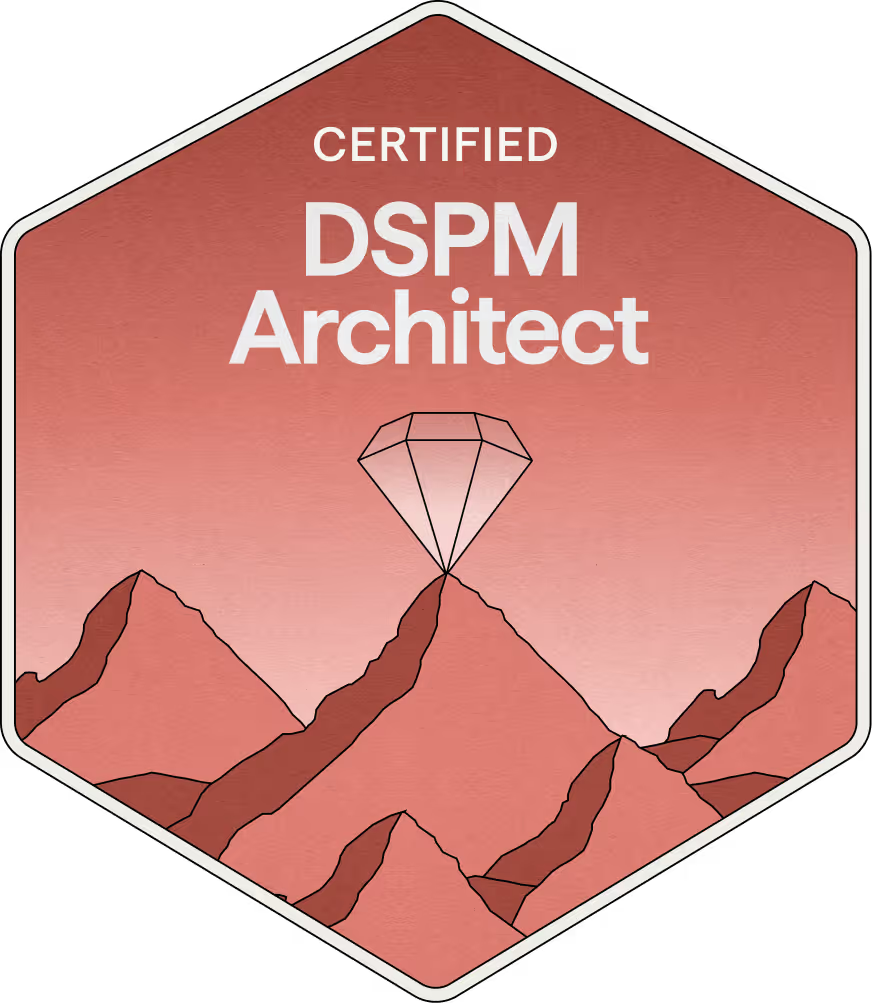
Certified DSPM Architect
Certified DSPM Architect is a practical certification for security, risk, compliance, data, and technology leaders building mature Data Security Posture Management programs across the full data lifecycle.
100% practical DSPM Training
Learn data security concepts that apply across cloud, SaaS, on-premises, hybrid, and AI-driven environments.
8 in-depth modules
Build a structured DSPM operating model across discovery, classification, governance, protection, monitoring, response, destruction, and maturity planning.
4 weeks to complete
Recommended pace: 3–4 hours per week.
Enroll to become a certified Data Security Architect
Build the expertise to design and mature an enterprise data security program with confidence. This certification shows how DSPM helps organizations discover and classify sensitive data, manage risk, enforce controls, and align security maturity with business and compliance goals.
What you’ll learn

Understand why perimeter-based security is no longer enough, and how DSPM enables data-centric security.
Explain DSPM’s role across the full data lifecycle: Discover, Classify, Govern, Protect, Control Flow, Monitor, Respond, and Destroy.
Discover and classify sensitive data across cloud, SaaS, on-premises, structured, unstructured, and forgotten repositories.
Govern data risk by identifying exposure, over-permissioning, misconfigurations, vulnerabilities, and compliance gaps.
Apply protection strategies such as least privilege, RBAC, MFA, zero trust, encryption, masking, tokenization, and AI-driven access enforcement.
Monitor data activity, detect anomalies, and respond using structured workflows, SIEM integration, automation, and AI-driven containment.
Establish secure destruction practices that reduce retention risk, eliminate ROT data, support compliance, and preserve audit evidence.
Build near-, mid-, and long-term DSPM action plans aligned to business goals, risk appetite, and available resources.
Skills
Data Security Posture Management
Data Discovery
Data Classification
Data Lifecycle Management
Data Governance
Data Risk Management
Data Attack Surface Reduction
Access Governance
Least Privilege Enforcement
Zero Trust Data Security
Data Activity Monitoring
Incident Response
Secure Data Destruction
Data Retention Management
DSPM Maturity Assessment
DSPM Roadmap Planning
Concepts & Frameworks
Cyera DSPM Maturity Model
Data Lifecycle Management
People, Process, and Technology Assessment
Current and Target Maturity Mapping
Near-, Mid-, and Long-Term Action Planning
GDPR Concepts
HIPAA Concepts
CCPA Concepts
PCI DSS Concepts
Zero Trust Principles
Role-Based Access Control
Data Risk Profiling
Data Attack Surface Management
ROT Data Management
Cryptographic Erasure
Security Operations Integration
Outcomes and takeaways
Build a practical DSPM operating model aligned to business objectives, compliance needs, and risk tolerance.
Use the Cyera DSPM Maturity Model across five domains: Discover & Classify, Govern, Protect & Control, Monitor & Respond, and Destroy.
Create practical artifacts including data inventories, classification frameworks, policies, remediation plans, access reviews, incident workflows, retention schedules, and action plans.
Understand how DSPM improves audit readiness, regulatory defensibility, stakeholder trust, and secure data enablement.
Develop a maturity-based roadmap that improves data security without over-investing beyond business risk.
Prioritize foundational improvements before introducing automation, metrics, AI-driven insights, and continuous optimization.
5000+ community of AI defenders
“Esta certificación hizo que los principios de seguridad de datos parecieran inmediatamente aplicables a nuestras iniciativas de IA.”
Amit Rustagi
Arquitecto de seguridad en la nube

“Esta certificación hizo que los principios de seguridad de datos parecieran inmediatamente aplicables a nuestras iniciativas de IA.”
Amit Rustagi
Arquitecto de seguridad en la nube

“Esta certificación hizo que los principios de seguridad de datos parecieran inmediatamente aplicables a nuestras iniciativas de IA.”
Amit Rustagi
Arquitecto de seguridad en la nube
“Esta certificación hizo que los principios de seguridad de datos parecieran inmediatamente aplicables a nuestras iniciativas de IA.”
Amit Rustagi
Arquitecto de seguridad en la nube
“Esta certificación hizo que los principios de seguridad de datos parecieran inmediatamente aplicables a nuestras iniciativas de IA.”
Amit Rustagi
Arquitecto de seguridad en la nube
Expert-Led Curriculum
The Security for AI Fundamentals certification is built to develop durable skills you can apply across tools, teams, and future roles as AI continues to evolve.
Module 0
Introduction to the certification
Textual
3 Hours
Understand who the certification is for, what skills learners should bring, and how the course helps professionals move from reactive data security to strategic DSPM leadership. Introduces the Cyera DSPM Maturity Model, maturity action steps, and DSPM Action Planning Table.
Module 1
Origin and evolution
Textual
3 Hours
Explore the evolution of data security, from protecting physical assets and ancient knowledge to securing modern data across cloud, SaaS, and AI-driven environments. Learn how assets, risks, and controls still shape DSPM strategy today.
Module 2
DSPM and data lifecycle management
Textual
3 Hours
Learn what DSPM is, how it supports each stage of the data lifecycle, and how the Cyera DSPM Maturity Model helps organizations assess capabilities, define target maturity, and build sustainable programs.
Module 3
Discover and classify
Textual
3 Hours
Learn how to locate, identify, and classify sensitive data across structured, unstructured, cloud, SaaS, on-premises, endpoint, and forgotten repositories. Explore how AI-powered classification improves accuracy, scale, and business context.
Module 4
Govern
Textual
3 Hours
Learn how to govern the data attack surface through policy, ownership, exposure management, misconfiguration reduction, and compliance alignment. Move from ad hoc vulnerability management to measurable, risk-based governance.
Module 5
Protect and control
Textual
3 Hours
Learn how to govern the data attack surface through policy, ownership, exposure management, misconfiguration reduction, and compliance alignment. Move from ad hoc vulnerability management to measurable, risk-based governance.
Module 6
Monitor and respond
Textual
3 Hours
Learn how to monitor sensitive data activity, detect anomalies, investigate suspicious behavior, and respond using structured workflows, SIEM integration, threat intelligence, automated triage, and AI-driven containment.
Module 7
Destroy
Textual
3 Hours
Understand how secure data destruction reduces risk, supports compliance, and lowers operational burden. Learn how to identify ROT data, apply retention policies, automate deletion, use cryptographic erasure, and maintain audit-ready records.
Module 8
Establishing & prioritizing action plans
Textual
3 Hours
Bring the DSPM program together by mapping current and target maturity, defining near-, mid-, and long-term goals, and building a phased roadmap that balances risk, compliance, business priorities, and resources.
Earn Your
DSPM Architect
certification!
DSPM Architect
certification!
Enroll to cecome a certified Data Security Architect
Sign up today to gain the expertise and recognition needed to lead AI security and governance programs with confidence.

.svg)