


Finding security issues is the easy part. Closing them is where data security programs break down.
Data securityy remediation requires the right people to act, with the right context, within a timeframe that actually reduces risk. That means routing issues to whoever owns the data, giving them enough information to make a decision, and ensuring that when nothing happens, something still gets done.
Most organizations have no systematic way to make that happen at scale. Issues get assigned. Emails get sent. And exposure persists because there is no loop that actually closes.
Cyera is built to close that loop, across three distinct remediation paths that reflect how data risk actually gets resolved in enterprise environments.
The challenge remediation has always faced
Security issues involving sensitive data are rarely the security team's to fix unilaterally. A publicly shared file containing PII, a misconfigured Shared Drive, a document with credentials sitting in the wrong folder, these belong to someone in the business. Deleting or locking down a file security does not own carries its own risk: it might be critical to a current project, or its removal might break a workflow that nobody knew depended on it.
That reality creates a genuine tension. Security needs the issue resolved. The person with the context and authority to resolve it safely is not on the security team.
The answer is not to remove the human from the loop. It is to design a loop that actually works.
Three paths from issue to closed
Cyera supports three remediation motions, each suited to different situations.
Delegated remediation routes issues to data owners — the people who own the files and have the context to decide what to do with them. This is the right path when the action required is disruptive enough that it should not be made without the owner's input.
Active remediation lets security teams fix issues directly from the Cyera platform, in bulk, using delegated permissions. This is the right path for clear-cut violations where no judgment call is needed, files that should never have been public, labels that need to be applied uniformly, permissions that are simply wrong.
Automated remediation chains both together. A single rule can delegate first, send a reminder if there is no response, escalate to a manager, and then fall back to active remediation if the issue still is not resolved. The data never stays exposed past a defined SLA, and every step is logged.
What the Remediation Center makes possible
Remediation breaks down when data owners have to chase issues across scattered views. The Remediation Center is the workspace that makes the Delegated path work at scale.
Instead of arriving as separate emails, each with its own link and context, issues are consolidated into a single portal per data owner. Every issue assigned to them, regardless of when it was sent or how it was routed, appears in one unified queue. The Remediation Center centralizes assigned work, progress, and audit history in one place, so security teams and data owners can collaborate to resolve data risk faster, with a clear record for compliance.
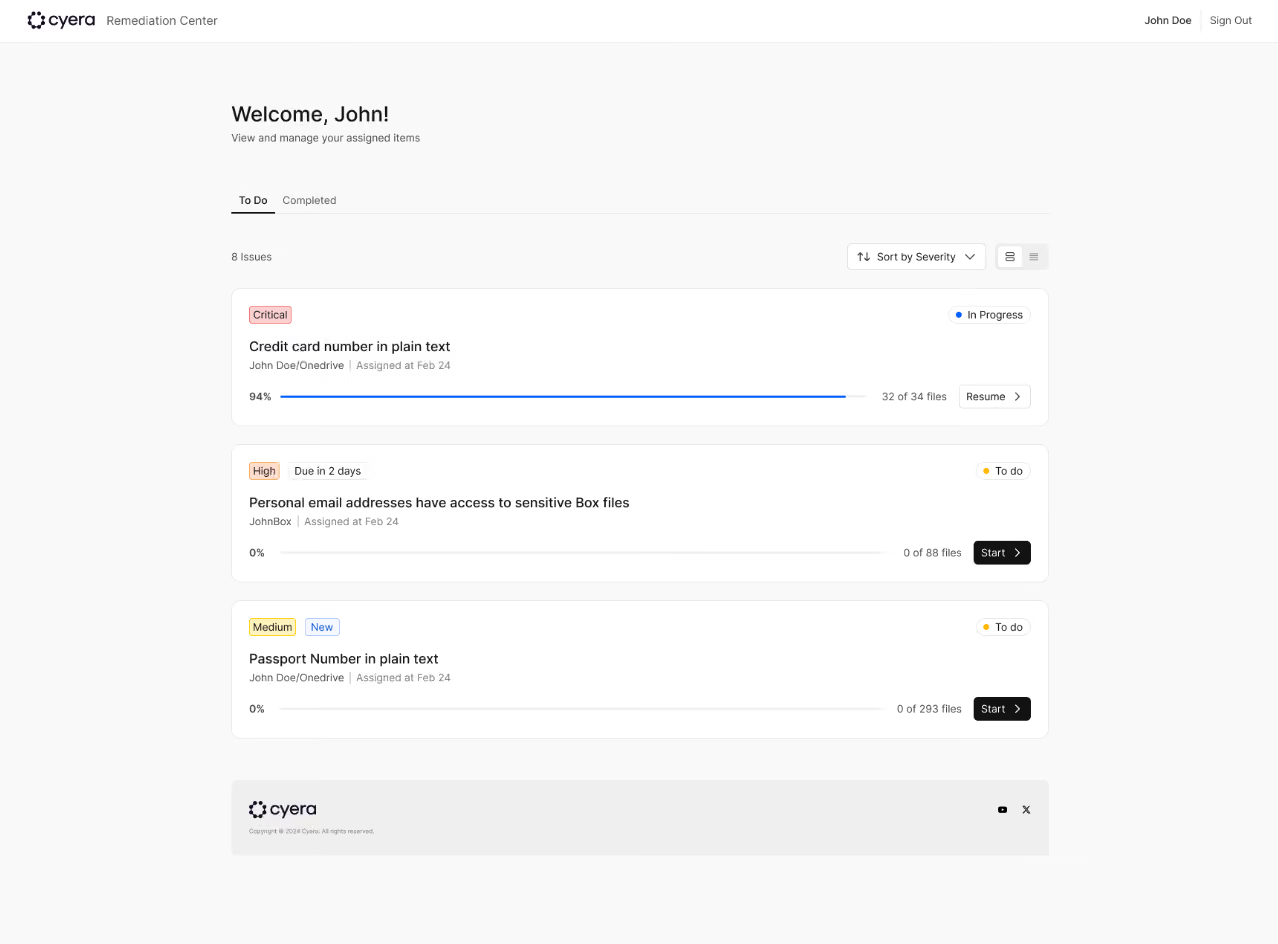
Here is what that enables in practice.
1) A single queue, not a scattered inbox
When issues arrive one at a time across email, Slack, and ticketing systems, data owners have no way to see the full picture of what they are responsible for. Issues get missed. Context gets lost between sends.
The Remediation Center gives every data owner a unified To Do view of all assigned issues, independent of how they were originally sent. One place to see, prioritize, and act on everything that is waiting for them without hunting through a fragmented inbox.
2) Context that actually gets issues resolved
Data owners are not security practitioners. A generic security alert such as "this file is exposed" does not give them enough information to know what to do, or whether the risk is worth acting on.
Because the Remediation Center is built on top of Cyera's DSPM, every issue arrives with the data context that makes a decision possible: what the file contains, why it was flagged, what the recommended action is. Owners can resolve the issue, accept the risk with a documented justification, or mark it as a false positive, all with a clear record of their decision.
3) The human loop is the faster fix
Portal-based owner remediation resolves significantly faster compared to other remediation paths. Getting the right person to act with the right context is not just the safer approach. It is the faster one.
Completed issues remain visible in a dedicated Completed tab for seven days, so owners can confirm their work was recorded and security teams can verify progress without following up manually.
4) A full audit trail at every step
Every action in the Remediation Center is logged. Login events, issue views, status updates, risk acceptances, and false positive markings are all captured and available to security teams for monitoring, compliance reporting, and audit evidence.
For organizations that need to demonstrate due diligence showing that issues were assigned, reviewed, and acted on within a defined timeframe, the event log makes that documentation straightforward.
5) Flexible, secure access for data owners
Data owners should not need a Cyera account or security training to fix an issue. The Remediation Center is designed for that reality.
One-time passcode (OTP) and SSO authentication are available in beta, giving organizations flexibility over how data owners access the portal while supporting existing identity and access management practices.
Remediation that actually closes
Finding data risk is a detection problem. Closing it is a collaboration problem, one that requires the right workflows, the right context, and a system designed to keep issues moving even when humans don't respond.
Cyera's three remediation paths cover the full range of how enterprise data risk actually gets resolved: owner-led when judgment is needed, security-led when speed matters, and automated when scale demands it. The Remediation Center is what makes the owner-led path work in practice, a workspace built for the people doing the fixing, not just the team assigning the work.
To see how Cyera's remediation capabilities work end to end, request a demo.

Get your AI Security Assessment
.jpg)
.jpg)

.svg)